
Telemedicine vs In-Person Visits: Cost Comparison
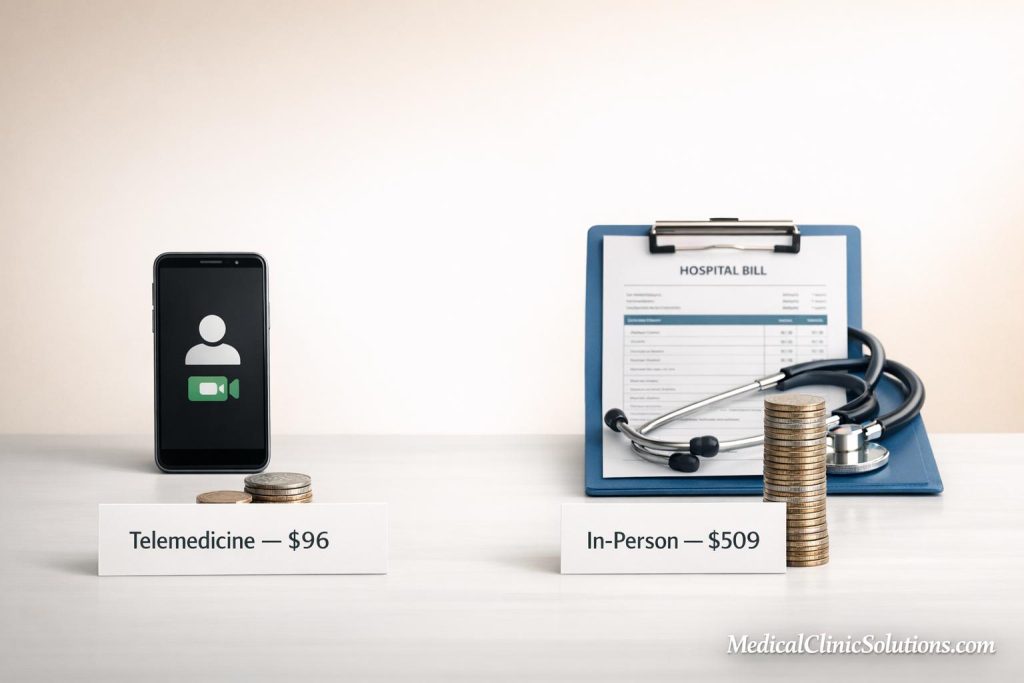
Telemedicine costs significantly less than in-person visits for many healthcare needs. A 2026 study from the University of Pennsylvania found that the average cost of a telemedicine care episode was $96, compared to $509 for in-person visits. This makes telemedicine nearly five times cheaper for treating common conditions.
Key points:
- Telemedicine saves money and time: Patients avoid travel, reduce lost productivity, and have shorter appointments.
- In-person visits cost more: Higher fees, travel expenses, and additional follow-ups increase costs.
- Providers benefit too: Telemedicine reduces overhead but requires upfront technology investment.
- Insurance matters: Coverage and reimbursement rules affect out-of-pocket costs for both options.
Quick Comparison:
| Factor | Telemedicine | In-Person Visits |
|---|---|---|
| Average Cost/Episode | $96 | $509 |
| Appointment Duration | ~15 minutes | ~90 minutes |
| Travel Costs | None | Gas, parking, transit |
| Follow-Up Visits | Fewer (~3 per episode) | More (~4 per episode) |
| Provider Costs | ~$380 per visit | ~$493 per visit |
Telemedicine works best for minor illnesses, follow-ups, and mental health care. For cases requiring physical exams or lab tests, in-person visits may be necessary. Always check insurance coverage to understand your costs.
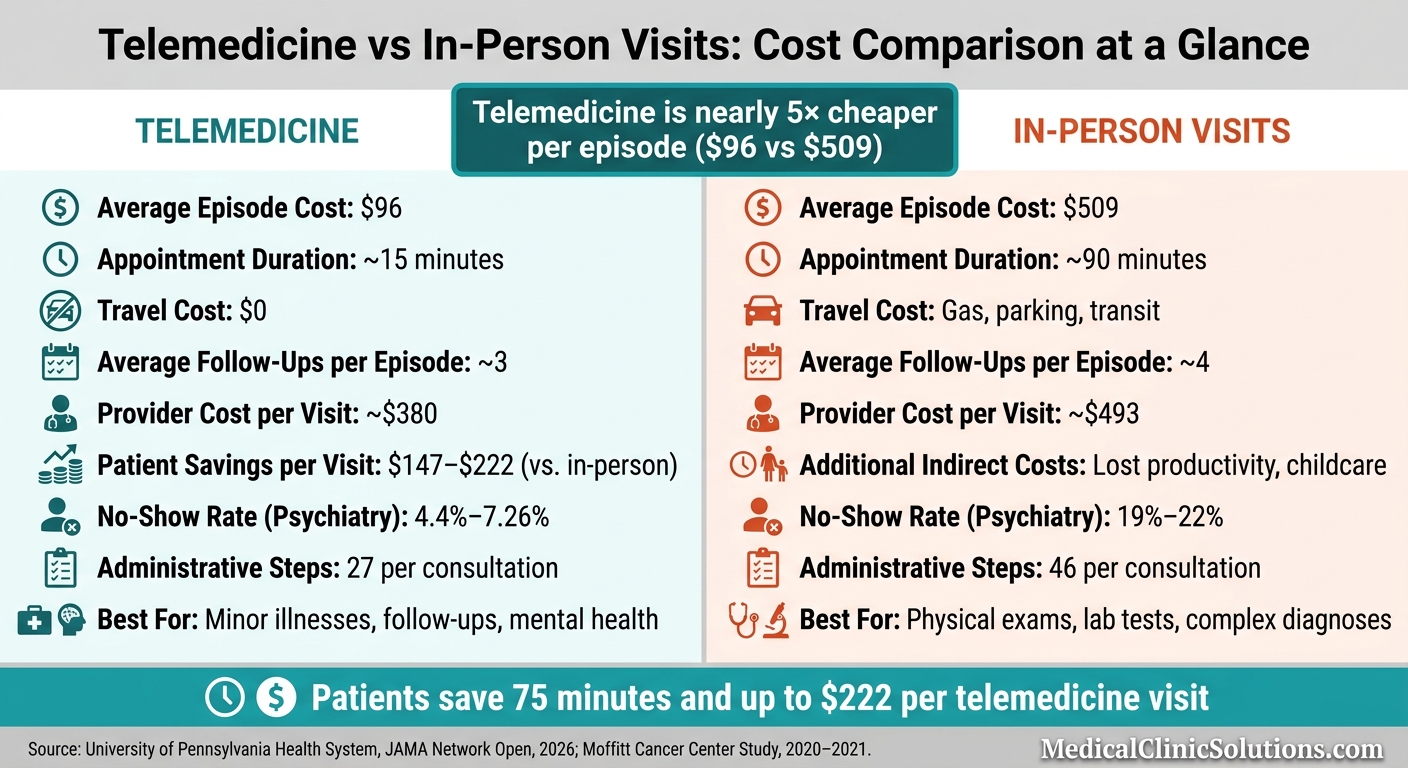
Telemedicine vs In-Person Visits: Cost Comparison at a Glance
Cost Breakdown of Telemedicine Visits
What Patients Pay for Telemedicine
For patients without insurance, the average cost of a 15-minute telemedicine visit is about $79, though fees can range from $40 to $120 depending on factors like the provider, appointment duration, and the condition being treated. Additional charges for prescriptions, lab work, or diagnostic referrals may also apply.
If you have insurance, your out-of-pocket costs will vary based on your plan’s coverage for virtual care. Some insurers treat telemedicine like a regular office visit, but others classify it as a "specialty service", which could mean higher copays or deductibles. Starting in 2026, hospital-based telemedicine platforms may reintroduce facility fees – charges that were largely waived during the pandemic but are returning as Medicare reimbursement rules evolve.
These baseline expenses give way to notable savings for patients, as detailed below.
Where Patients Save Money with Telemedicine
A study of over 25,000 telehealth visits at Moffitt Cancer Center (conducted from April 2020 to June 2021) found that patients saved between $147.40 and $186.10 per visit when factoring in travel and lost productivity. For new patient consultations, the savings climbed to $222.80 per visit. This is largely because an in-person visit, including commuting and waiting, typically takes about 90 minutes, while a telemedicine appointment averages just 15 minutes. That’s roughly 75 minutes saved per visit, which can be used for work, childcare, or other responsibilities.
"Our work suggests that for many patients, telemedicine can be a complete solution, not just a temporary band-aid." – David Asch, MD, MBA, Professor and Senior VP for Strategic Initiatives, University of Pennsylvania
Another advantage is fewer follow-up appointments. A 2026 study by the University of Pennsylvania Health System, covering 160,000 visits, revealed that patients who started care virtually averaged 3 follow-ups, compared to 4 follow-ups for those who began with in-person visits. This reduction not only lowers costs but also minimizes disruptions to daily life.
While patients enjoy these savings, it’s important to examine the financial realities for providers.
What Telemedicine Costs Providers
For providers, telehealth visits cost about $380 per visit, compared to $493 for in-person visits. Clinics save primarily on reduced facility overhead, including lower expenses for physical space, utilities, and staffing.
However, the initial technology investment is steep. Setting up a compliant telehealth system costs between $17,000 and $50,000, covering hardware, software, and specialized equipment. Monthly fees for HIPAA-compliant video software run around $150 per user, with subscription plans ranging from $200 to $400 per user depending on features like registry reporting and 24/7 support. Additionally, integrating these platforms with existing electronic health records (EHR) and billing systems often requires custom development.
Revenue challenges also exist. Changes to Medicare reimbursement rules in 2026 have reduced payment parity for certain telehealth codes, leading some clinics to increase patient fees to compensate. Furthermore, telemedicine visits see a lower follow-up rate – 6% compared to 13% for traditional office visits. While this reduces administrative workload, it can also impact the number of billable appointments.
Telemedicine Cost Summary Table
| Cost Component | Patient Perspective | Clinic Perspective |
|---|---|---|
| Consultation Fee | $79 average (self-pay); varies by insurance | ~$380 per visit delivery cost |
| Facility/Tech Fees | Facility fees may appear on hospital bills in 2026 | $150 per user/month platform fees; $17K–$50K setup |
| Indirect Costs | Saves ~75 minutes and $147–$222 per visit | Reduced physical overhead and flexible staffing |
| Follow-up Costs | Fewer follow-ups (avg. 3 vs. 4 for in-person) | Lower follow-up rate (6% vs. 13%) reduces admin load |
Cost Breakdown of In-Person Visits
What Patients Pay for In-Person Visits
The cost of an in-person medical visit depends on several factors, including insurance coverage, location, and the type of provider. For patients with insurance, the average national commercial price for a level 3 primary care visit is $145.20 for new patients and $101.60 for established patients. However, uninsured patients face much steeper costs, typically paying $200 to $400 for a primary care visit and $300 to $800 for a specialist consultation.
Corporate-owned physician practices tend to charge more, with prices averaging 17.9% higher for new patient visits compared to independent practices. Additionally, organizations with over 100 physicians negotiate rates that are 28% higher than solo practices. Urban clinics also add to the financial burden, running 30–50% more expensive than their rural counterparts. For urgent care, patients can expect to pay $150 to $300 out of pocket, while emergency room visits can climb to $1,000 to $3,000 or more.
These upfront costs are just the beginning, as in-person visits often come with additional expenses.
Additional Costs Patients Face with In-Person Visits
Beyond the appointment fee, patients incur other costs that can significantly add up. Travel expenses, such as gas, parking, or public transit, are unavoidable, especially for those who live far from their provider. The time spent commuting and waiting for the appointment also extends the overall commitment, making the process more taxing.
For patients requiring follow-up care, the financial and logistical challenges multiply. Additional copays, time off work, and planning for childcare or caregiving responsibilities all contribute to the overall cost of in-person care. These indirect expenses widen the financial gap between in-person visits and other care models.
"If telemedicine is allowed to revert to the more limited model that existed before COVID, the cost savings we identified could disappear. At a moment when hospitals and health systems face serious financial headwinds, those savings are vital." – Kevin B. Mahoney, CEO, University of Pennsylvania Health System
These patient costs exist alongside the substantial operational expenses faced by providers.
What In-Person Visits Cost Providers
Running a physical clinic is expensive. Providers must cover the costs of leasing and maintaining large spaces, paying utilities, keeping medical equipment operational, and staffing reception and exam rooms. These costs remain fixed, regardless of how many patients are seen. According to The Care MD, "Telehealth providers don’t incur high facility fees, as they don’t need to lease large spaces to accommodate patients or pay high operational costs".
Missed appointments only add to the financial strain, as the fixed costs of running a clinic must then be distributed across fewer billable visits. This drives up the per-visit cost for the clinic, which often leads to higher fees for patients. These structural challenges highlight the inherent cost disadvantages of in-person care.
In-Person Visit Cost Summary Table
| Cost Component | Patient Impact | Clinic Impact |
|---|---|---|
| Primary Care Fee (Insured) | $101.60–$145.20 mean commercial price | Offset by overhead and staffing costs |
| Primary Care Fee (Uninsured) | $200–$400 per visit | Higher revenue but no contractual discounts |
| Specialist Consultation | $300–$800 (uninsured) | Higher reimbursement, higher facility demand |
| Urgent Care / ER | $150–$3,000+ depending on setting | High equipment and staffing overhead |
| Travel & Indirect Costs | Gas, parking, transit, childcare, lost wages | No direct impact, but no-shows increase per-visit costs |
| Follow-up Volume | Increased follow-up demands within 30 days | Increased scheduling and administrative load |
| Full Episode Cost | ~$509 average per episode | Higher facility and ancillary service utilization |
Evaluating the impact of telehealth on costs, access and quality
Telemedicine vs In-Person Costs by Visit Type
When it comes to healthcare expenses, the type of visit makes a big difference. Here’s a look at how telemedicine stacks up against in-person care for various conditions, from minor illnesses to chronic and mental health care.
Minor Illnesses and Follow-Up Appointments
For minor illnesses, telemedicine proves to be a much cheaper option. A 2026 study revealed that the average cost for an episode starting with a telemedicine visit was just $96, compared to $509 for episodes beginning with in-person care – an over 80% difference. For respiratory symptoms in particular, telemedicine appointments saved patients around $800 per episode. These findings back earlier research showing telemedicine’s cost advantage for acute conditions.
Another benefit? Patients who started with telemedicine needed fewer follow-ups, which further cut down overall costs. A 2025 study published in BMC Health Services Research analyzed over 455,000 acute care episodes across a large U.S. health plan. It found that virtual-first care was 33% cheaper for UTIs among commercially insured patients and 14% to 25% cheaper for sinusitis, depending on the insurance type.
"Before we did this study, there was a common concern that telemedicine might serve only as an easy source of ‘first aid,’ just delaying in-person care and increasing costs overall. But we found that wasn’t true, and our work suggests that for many patients, telemedicine can be a complete solution, not just a temporary band-aid." – David Asch, MD, MBA, Professor and Senior Vice President for Strategic Initiatives, University of Pennsylvania
Chronic Disease and Mental Health Appointments
The cost savings seen in acute care extend to chronic and mental health conditions, though the differences are less dramatic. For mental and behavioral health visits, the costs for telemedicine and in-person care are nearly identical. This is because these appointments often focus on counseling and medication management, which don’t require lab tests or imaging.
"Many systems already deliver most psychiatric care via telemedicine since care is dominated mostly by counseling and medication management instead of through tests or procedures… treatment and prescribing workflows may look similar across visit types and make episode charges comparable, even though telemedicine is still associated with fewer subsequent visits." – Bingyu Zhang, MS, Applied Mathematics & Computational Science PhD student, Penn Computing, Inference and Learning (PennCIL) lab
Even with similar per-visit costs, telemedicine excels at reducing follow-ups. For conditions like neurodevelopmental and sleep-wake disorders, telemedicine continues to show the same five-times-cheaper trend seen in acute care. The BMC Health Services Research study also highlighted that virtual-first care cut episode costs by 20% to 27% for gastroenterology conditions and 20% to 28% for rhinitis among commercially insured members.
Cost Comparison Table by Visit Type
| Visit Type | Telemedicine Cost | In-Person Cost | Study Reference |
|---|---|---|---|
| General Common Conditions (avg. episode) | $96 | $509 | Penn Medicine, JAMA Network Open |
| Respiratory Symptoms | ~$800 less than in-person | Baseline | Penn Medicine, JAMA Network Open |
| Urinary Tract Infection (Commercial) | 33% lower | Baseline | BMC Health Services Research |
| Sinusitis | 14%–25% lower | Baseline | BMC Health Services Research |
| Bronchitis | 11%–15% lower | Baseline | BMC Health Services Research |
| Gastroenterology Disease | 20%–27% lower | Baseline | BMC Health Services Research |
| Rhinitis | 20%–28% lower | Baseline | BMC Health Services Research |
| Minor Bacterial Skin Infection | 9%–17% lower | Baseline | BMC Health Services Research |
| Mental & Behavioral Health | Comparable | Comparable | Penn Medicine, JAMA Network Open |
Hidden and Long-Term Costs to Consider
When comparing telemedicine to in-person care, it’s crucial to look beyond the obvious fees. Several hidden factors contribute to the overall cost differences, some of which might not be immediately apparent.
The Dollar Value of Time Spent on Each Visit Type
One of telemedicine’s biggest advantages is the time it saves. Patients skip travel entirely and often require fewer follow-up visits, cutting down on both time and indirect costs. For example, in 2018, the Centers for Medicare & Medicaid Services (CMS) estimated that telemedicine saved Medicare patients $60 million in travel costs. That number is expected to grow to $170 million by 2029.
Providers also see benefits, as telemedicine reduces operational demands, allowing them to manage their time and resources more efficiently.
Technology Costs vs Physical Facility Costs
Telemedicine shifts the burden of traditional overhead costs – like rent, utilities, and maintenance – to technology-related expenses. This change simplifies processes, slashing administrative steps from 46 to just 27 per consultation. Additionally, telemedicine significantly reduces no-show rates. For instance, psychiatry services report no-show rates of 4.4%–7.26% for virtual visits, compared to 19%–22% for in-person appointments. Fewer no-shows mean more revenue for providers and better access for patients.
How Insurance and Reimbursement Affect Costs
Insurance coverage and reimbursement policies play a big role in determining telemedicine’s cost-effectiveness. During the pandemic, temporary federal waivers ensured high reimbursement rates for telemedicine services. However, if these policies expire, as they might in 2027, patients could see reduced savings due to lower payment parity.
Kevin B. Mahoney, CEO of the University of Pennsylvania Health System, noted the potential impact:
"If telemedicine is allowed to revert to the more limited model that existed before COVID, the cost savings we identified could disappear."
It’s also worth noting that telemedicine isn’t always cheaper. For example, treating infectious disease exposure via telemedicine cost 4% more than in-person care for some commercially insured members. This was largely due to the need for additional testing and follow-up monitoring. The type of insurance – whether commercial, Medicare Advantage, or Medicaid – further influences these cost dynamics, adding another layer to consider.
Hidden Cost Summary Table
| Cost Factor | Telemedicine Impact | In-Person Impact | Net Financial Implication |
|---|---|---|---|
| Travel & Commute | $0 direct cost; no travel time | Fuel, parking, and transit costs | Telemedicine saves $20–$100+ per visit in indirect costs |
| Follow-up Frequency | Avg. ~3 visits per episode | Avg. ~4 visits per episode | Fewer appointments reduce long-term time and cost burden |
| Administrative Steps | 27 steps per consultation | 46 steps per consultation | Streamlined workflows boost efficiency |
| No-Show Rates | 4.4%–7.26% (psychiatry) | 19%–22% (psychiatry) | Reduced no-shows help recover missed revenue |
| Facility Overhead | Low; platform and tech fees | High; rent, utilities, and maintenance | Lower fixed costs for providers |
| Reimbursement Stability | Subject to federal waivers; may lapse in 2027 | Standardized, established rates | Future telemedicine costs may rise if temporary policies expire |
These hidden costs and savings present a more nuanced view of the financial trade-offs in telemedicine versus in-person care. Both patients and providers need to weigh these factors when deciding which model works best for their needs.
Conclusion: Selecting the Most Cost-Effective Care Approach
Telemedicine can lead to considerable cost savings when used in the right scenarios. For example, a February 2026 study by researchers at the University of Pennsylvania analyzed 160,000 visits and found that telemedicine episodes cost an average of $96, compared to $509 for in-person visits. While the savings are more pronounced for acute conditions, the gap narrows when dealing with chronic cases.
To get the most value, it’s essential to align the type of visit with the medical need. Telemedicine works best for minor acute illnesses, routine follow-ups, and mental health consultations. On the other hand, in-person visits are better suited for cases requiring physical examinations or lab tests. This thoughtful approach not only reduces costs for patients and providers but also ensures effective care delivery.
Reimbursement policies also play a role in determining overall savings. While 37 states require parity for telemedicine, the specifics of reimbursement can vary depending on your insurance plan and the type of telemedicine service used. Always double-check your coverage details to avoid surprises.
For clinics considering whether to expand their telemedicine services, the financial benefits are clear, but successful implementation is key. Decisions should balance both clinical needs and financial considerations – a theme consistent throughout this discussion.
Medical Clinic Solutions simplifies this process for clinics. Whether you need help selecting telemedicine software, refining billing processes, or finding the right providers for your practice, they can connect you with the tools and services that fit your needs, giving you peace of mind in your decision-making.
FAQs
Is telemedicine cheaper after copays and deductibles?
Telemedicine tends to be easier on the wallet when you consider copays and deductibles. Research highlights that telehealth appointments are often much cheaper than traditional in-person visits. Why? Lower service fees, no travel costs, and fewer follow-up appointments add up to significant savings. While you’ll still need to cover out-of-pocket expenses like copays or deductibles, many patients find telemedicine to be a cost-effective alternative.
When do I still need an in-person visit instead?
When a physical examination is essential for diagnosis or treatment – like palpation, auscultation, or on-site testing – in-person visits become indispensable. Emergencies, severe symptoms, or complex procedures requiring direct hands-on care also demand face-to-face interaction. Certain conditions simply need immediate, precise physical assessments that telemedicine can’t fully address.
Can telemedicine bills include facility fees in 2026?
In 2026, telemedicine bills can include facility fees. However, back in 2020 and 2021, reimbursement rates for telehealth services were typically lower than those for in-person visits. These rates often depended on factors like the payer and the location of the service.