
10 Ways to Reduce No-Shows in Your Medical Practice
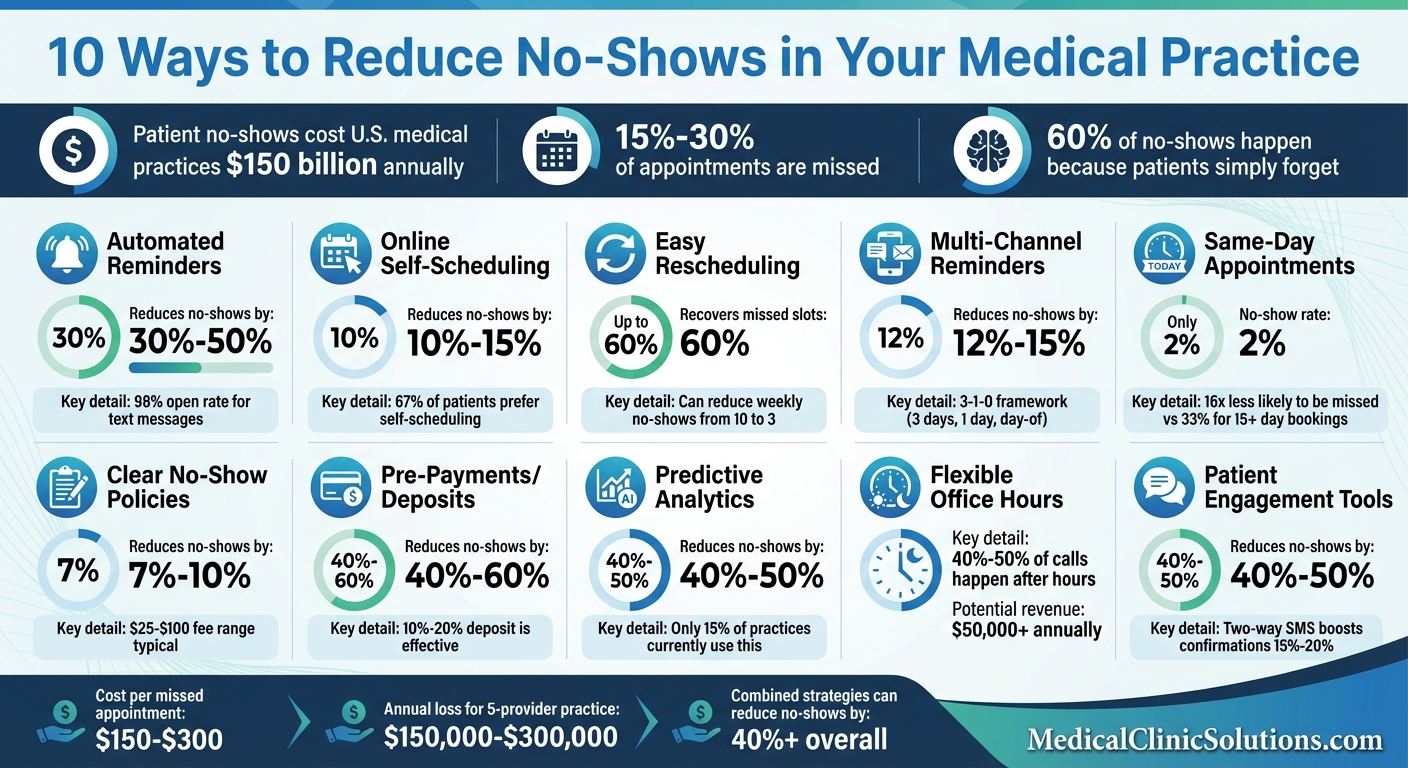
Patient no-shows cost U.S. medical practices $150 billion annually, with 15%-30% of appointments missed. The good news? Up to 60% of no-shows happen because patients simply forget. By implementing the right strategies, you can reduce missed appointments, recover lost revenue, and optimize your schedule. Here’s how:
- Automated Reminders: Texts, emails, and calls reduce no-shows by 30%-50%.
- Online Self-Scheduling: Patients booking their own appointments lowers no-shows by 10%-15%.
- Easy Rescheduling: Simplified options recover up to 60% of missed slots.
- Same-Day Appointments: Shorter booking windows cut no-show rates significantly.
- No-Show Policies: Clear rules and fees encourage accountability.
- Pre-Payments: Small deposits reduce no-shows by 40%-60%.
- Predictive Analytics: AI tools identify high-risk patients to focus outreach.
- Flexible Hours: Adjusting office hours to patient needs improves attendance.
- Patient Engagement Tools: Two-way communication boosts confirmations.
- Multi-Channel Reminders: Combining texts, emails, and calls maximizes reach.
These methods not only reduce no-shows but also improve patient satisfaction and clinic efficiency. Now, let’s dive into the details.
10 Proven Strategies to Reduce Medical Practice No-Shows with Success Rates
The 5 BEST Ways To Reduce No-Shows At Your Practice
1. Use Automated Appointment Reminders via Medical Clinic Solutions
Automated appointment reminders are a powerful way to tackle one of the most common issues in medical practices: no-shows. Since 80% of missed appointments happen because patients simply forget, these reminders solve the problem without adding extra work to your staff’s plate.
Effectiveness in Reducing No-Shows
Practices that use automated reminders often report a 30% to 50% drop in no-show rates. A tried-and-true method is the 3-1-0 framework: send reminders 3 days before the appointment, 1 day prior for confirmation, and a final reminder on the day of the visit with directions.
Text messages are especially effective, boasting a 98% open rate – 90% of which are read within minutes. Compare that to emails, which typically see only about a 20% open rate. Additionally, 64% of patients prefer text reminders. Some systems even allow two-way SMS, where patients can reply "C" to confirm or "R" to reschedule. This simple feature has been shown to further reduce no-shows by 8% to 12%.
Take Castle Hills Family Practice in San Antonio as an example. In April 2026, they saw no-shows drop by 40% after introducing automated reminders. For this two-physician practice managing over 5,200 patient calls monthly, the system also cut phone-related workload in half.

Next, let’s look at how easily these systems can integrate with your existing tools.
Ease of Implementation in Medical Practices
Modern automated reminder systems work seamlessly with your existing EHR, making implementation straightforward. Once set up, reminders are triggered automatically based on your appointment schedule. Patient responses – whether they confirm, cancel, or reschedule – are updated directly in their records, saving time and reducing errors.
A great example is Hudson Headwaters Health Network, which operates 89 offices across New York. In early 2026, they launched an AI-powered communication platform. This system now handles 68.1% of patient calls during business hours, allowing staff to focus on high-risk patients who need personalized attention.
Cost-Effectiveness for Clinics
Beyond improving attendance, automated reminders free up staff time and streamline operations. Manually calling patients takes 2–4 minutes per call. For a practice with 30 or more daily appointments, this can add up to over 4 hours of staff time weekly. And with 86% of people ignoring calls from unknown numbers, manual outreach often isn’t effective.
The financial impact of no-shows is significant. Each missed appointment can cost $150–$300, translating to annual losses of $150,000–$300,000 for a typical five-provider practice. By cutting no-show rates, automated reminders can quickly recoup their costs. Many systems offer flexible pricing models, such as pay-as-you-go plans or free trials, so you can assess the benefits before fully committing.
2. Add Online Self-Scheduling with Patient Portals
Letting patients book their own appointments online doesn’t just bring your practice into the digital age – it can significantly cut down on no-shows. When patients pick their own time slots through a portal, they’re more likely to choose times that fit their schedules, avoiding the uncommitted bookings that often happen when they settle for times offered over the phone.
Effectiveness in Reducing No-Shows
Allowing patients to actively select their appointments creates a stronger sense of commitment. Practices that implement self-scheduling have seen no-show rates drop by 10% to 15% compared to appointments scheduled by staff. Timing also plays a big role: appointments booked more than 15 days in advance can see no-show rates as high as 33%, while same-day bookings reduce that to just 2%. With 67% of patients preferring to schedule their own appointments, offering this option aligns with their expectations.
Ease of Implementation in Medical Practices
Modern self-scheduling tools are designed to integrate seamlessly with existing electronic health records (EHR) and practice management systems, such as athenahealth, Veradigm, or Altera. These systems provide real-time availability, eliminating double bookings and ensuring a smooth scheduling process. Features like one-click rescheduling allow patients to adjust their appointments in under 40 seconds, bypassing frustrating phone systems. Automated waitlist management further optimizes scheduling by notifying patients of openings due to cancellations, helping to fill slots quickly. These streamlined tools not only reduce administrative headaches but also improve the overall experience for both staff and patients.

Impact on Patient Satisfaction
The convenience of 24/7 scheduling through patient portals takes satisfaction to the next level. Patients can book or reschedule appointments whenever it suits them – early morning, late at night, or even on weekends – eliminating long hold times and giving them more control.
"Self-scheduling tools are a game-changer because they give patients the flexibility to book appointments whenever it’s convenient for them – whether it’s early in the morning, late at night, or on the weekend." – Amazing Charts
When rescheduling is made easy, patients are more likely to update their appointments instead of skipping them entirely. Some practices have seen drastic improvements, reducing no-shows from 10 to just 3 per day by removing barriers to cancellation and rescheduling. While it may seem counterintuitive, simplifying the process of canceling or changing appointments actually helps keep schedules full and reduces missed visits.
Cost-Effectiveness for Clinics
The financial benefits of self-scheduling systems are clear. By cutting no-shows by 10% to 15%, these tools can pay for themselves quickly. They also free up front desk staff from the time-consuming tasks of phone scheduling, allowing them to focus on more critical responsibilities like patient care coordination. Intelligent rescheduling features can recover up to 60% of lost appointments, while automated waitlists ensure that cancellations don’t leave gaps in the schedule. This combination keeps your clinic running efficiently and maximizes productivity.
3. Allow Easy Rescheduling through Practice Management Software
Building on the benefits of automated reminders and self-scheduling, enabling simple rescheduling can significantly reduce no-shows. Missed appointments often turn into managed cancellations when patients have an easy way to reschedule. Nobody enjoys navigating endless phone menus to change an appointment. By offering effortless rescheduling, practices can transform potential no-shows into opportunities to refill canceled slots from a waitlist, minimizing revenue loss.
Effectiveness in Reducing No-Shows
Practices that implement self-service rescheduling options report a 10% to 15% improvement in patient attendance rates. For example, online rescheduling has been shown to lower the median no-show rate from 5.9% to 1.8%. One case study highlighted a 40% drop in no-shows after introducing automated communication and rescheduling tools across two offices handling over 5,200 monthly calls. These results build on earlier gains achieved through automated reminders and self-scheduling systems.
When rescheduling is as simple as tapping a link instead of making a phone call, patients are far more likely to update their appointment rather than skip it. One practice reduced weekly no-shows from 10 to just 3 by converting silent absences into managed cancellations. In fact, rescheduling systems can recover up to 60% of appointments that might otherwise be lost.
Ease of Implementation in Medical Practices
Modern practice management software integrates seamlessly with Electronic Health Record systems like athenahealth, Veradigm, and Altera TouchWorks, ensuring real-time schedule updates without the need for manual input. These tools offer features such as:
- One-tap rescheduling links included in SMS and email reminders
- 24/7 self-scheduling interfaces that work outside regular office hours
- Automated waitlist management to instantly fill newly available slots
The best systems remove barriers like forgotten portal passwords or complicated logins. Instead, they provide direct links that guide patients through rescheduling in under 40 seconds.
Impact on Patient Satisfaction
According to an MGMA poll, 73% of medical practices that successfully reduced or stabilized their no-show rates credit easy cancellation and rescheduling options for their success. Patients value the convenience and flexibility of managing their appointments, especially during off-hours.
"Making it easier to cancel actually helps decrease appointment no-shows. It sounds backward, but the data backs it up." – Curogram
Two-way texting further enhances the experience by allowing patients to reply directly to reschedule. They can instantly view and select alternative time slots, removing the frustration that often leads to skipped appointments.
Cost-Effectiveness for Clinics
Missed appointments can cost a clinic $200 each. For a primary care practice with a 20% no-show rate, this translates to an annual loss of $90,000 to $180,000 in unfilled slots. Automated waitlist systems can recover 50% to 70% of last-minute cancellations, converting lost revenue into productive patient visits.
Additionally, front-desk staff save time by avoiding phone tag, allowing them to focus more on patient care. Many rescheduling solutions operate on pay-as-you-go models, charging based on actual usage rather than requiring costly monthly fees. This makes these tools an efficient and budget-friendly choice for clinics.
4. Send Reminders through Text, Email, and Phone Calls
Making rescheduling simple is a great start, but ensuring patients actually show up requires reaching them at the right time and through the right channels. Using a mix of text messages, emails, and phone calls ensures your reminders land, no matter the patient’s age or communication habits. This multi-channel approach tailors outreach to fit individual preferences, significantly reducing no-shows.
Effectiveness in Reducing No-Shows
Text messages are incredibly effective, with a staggering 98% open rate compared to email’s 20–30%. Even better, 90% of texts are read within three minutes of being sent. Practices that combine SMS, email, and phone reminders see no-show rates drop by 12–15% compared to using a single method.
Timing also plays a big role. A "3-1-0 cadence" – sending reminders three days before the appointment (to create awareness), one day before (for confirmation), and on the day of (for logistics) – can slash no-show rates by as much as 52%.
Take this real-world example: a small primary care practice in Atlanta moved from manual phone calls to automated two-way texting. In just 60 days, their no-show rate plummeted from 24% to 14%, recovering an estimated $78,000 in revenue in the first year.
Two-way communication systems, where patients can reply with simple codes like "C" to confirm or "R" to reschedule, are even more effective. These systems can improve show rates by 20–30% compared to one-way notifications.
"Text messaging is the most effective way to reduce patient no-shows in any practice, at any scale." – Jo Galvez, March 2026
Ease of Implementation in Medical Practices
Adopting a layered communication strategy is easier than you might think. Modern reminder platforms sync directly with your practice management and EHR systems, automating the process and eliminating manual data entry. Setup typically involves obtaining patient consent for HIPAA compliance, creating message templates, and configuring the timing of reminders.
Here’s how it works:
- Use SMS for its speed and reach.
- Send emails for detailed instructions or follow-ups.
- Reserve phone calls as a last resort for unconfirmed or high-priority appointments.
Since 86% of people ignore calls from unknown numbers and over 80% of healthcare reminder calls go straight to voicemail, phone calls should only serve as a backup.
Personalization can make a big difference. Including the patient’s first name, the provider’s name, and the office location in reminders can boost confirmation rates by 15–20%. Most platforms handle this automatically by pulling data from your scheduling tools.
Impact on Patient Satisfaction
Patients overwhelmingly favor text reminders. In fact, 64% prefer them, and 97% want the option to receive reminders via SMS. Texts are less disruptive than phone calls and let patients respond instantly without dealing with phone menus or hold times.
When patients can confirm or reschedule with just a tap, they feel more in control of their healthcare. This ease of use improves their overall experience and strengthens their trust in your practice.

Cost-Effectiveness for Clinics
Automated, HIPAA-compliant reminder systems typically cost between $100 and $600 per month, depending on features and practice size. Considering that missed appointments cost around $150–$200 each, even ten no-shows per week can translate to $1,500–$2,000 in lost revenue – or up to $104,000 annually. By recovering even half of these missed visits, the system pays for itself many times over.
One high-volume practice calculated a potential ROI of 13,864%, while most clinics see a clear return within their first month. Beyond revenue recovery, these systems free up over two hours daily for front-desk staff, allowing them to focus on patient care, billing, and other important tasks.
5. Reduce Booking Windows for Same-Day Appointments
When patients book their appointments far in advance, the chances of them forgetting or running into scheduling conflicts increase significantly. In fact, same-day appointments have a no-show rate as low as 2%, while appointments booked 15 or more days ahead can see no-show rates climb to 33% – making long-lead bookings about 16 times more likely to be missed.
Effectiveness in Reducing No-Shows
Shorter booking windows help minimize the likelihood of unexpected events or forgetfulness, which account for 40–50% of missed appointments. By limiting scheduling to a 2–4 week window, patients are more likely to remember their commitments, and the sense of urgency remains intact.
"Every day you shave off the booking-to-appointment gap measurably reduces no-shows." – Appointment Reminder
Using strategies like “open scheduling” to prioritize same-day slots can keep your calendar productive. Filling today’s openings reduces the risk of no-shows and has consistently been ranked as one of the most effective and straightforward methods to address this issue.
Ease of Implementation in Medical Practices
This approach doesn’t require fancy tools or expensive technology – just a tweak in scheduling policies and some staff training. Here’s how to get started:
- Limit most appointments to a 2–4 week booking window.
- Set aside daily slots for walk-ins or urgent cases like ear infections or strep throat.
- Actively promote same-day or next-day availability.
- Maintain a “short notice” list of patients who can fill cancellations quickly.
For practices that must schedule further in advance, adding extra reminders at intervals like 7 days, 48 hours, and 2 hours before the visit can help keep patients on track.
Impact on Patient Satisfaction
Patients value quick access to care. Long wait times – spanning weeks or months – often push them toward alternatives like Emergency Departments or Urgent Care Centers. Shorter booking windows not only meet patient expectations but also address their need for timely treatment, particularly for acute issues.
Cost-Effectiveness for Clinics
Each missed appointment costs an average of $200, and U.S. healthcare providers lose an estimated $150 billion annually due to no-shows. Reducing booking windows is a simple, policy-driven solution that can help clinics recapture lost revenue. By prioritizing same-day appointments over high-risk, long-lead bookings, clinics can fill slots more reliably. Best of all, this strategy doesn’t require additional spending – just a shift in how appointments are managed.
6. Create a Clear No-Show Policy in Patient Agreements
Building on strategies like automated reminders and easy rescheduling, having a clear no-show policy is another way to encourage patient accountability. A documented policy sets expectations and helps patients understand their responsibilities. When patients are aware of potential consequences for missed appointments, they’re more likely to show up or cancel in advance. The key is to make the policy straightforward and consistently communicate it – starting with the intake form and continuing through appointment reminders.
Effectiveness in Reducing No-Shows
Just informing patients about a no-show policy can reduce missed appointments by 7% to 10%. It helps reinforce the idea that appointments are commitments, not informal plans. When patients sign or acknowledge the policy digitally during intake, it reduces misunderstandings about the rules.
Effective policies typically include the following:
- A 24- to 48-hour cancellation window.
- A fee ranging from $25 to $100.
- A definition of a no-show, such as arriving more than 15 minutes late.
- Exceptions for emergencies like hospitalization, bereavement, or severe weather.
Some practices use a progressive system, such as issuing a warning for the first offense, a fee for the second, and requiring prepayment or dismissal after repeated no-shows. This approach balances accountability with the goal of retaining patients.
Ease of Implementation in Medical Practices
Implementing a no-show policy doesn’t require costly tools. Most practice management software can handle digital signatures for agreements, and reminders can include brief mentions of the policy. You can also post the policy on your website, display it in the waiting room, and include it in intake forms.
To maintain goodwill, frame the policy in a positive light. For example, use language like "To ensure all patients have access to timely care". This approach complements other strategies while reinforcing the importance of patient commitment.
"HealthTexas believes that a good physician/patient relationship is based upon understanding and good communication." – HealthTexas Medical Group
Impact on Patient Satisfaction
While no-show policies can seem strict, using empathetic language and offering some flexibility can help minimize any negative feelings. Explaining that missed appointments prevent others from receiving timely care helps patients see the broader impact without feeling penalized.
Another option is a "fee erased upon return" system, which encourages patients to rebook while still holding them accountable.
Cost-Effectiveness for Clinics
With the average no-show costing a practice $200 in lost revenue, and some clinics losing as much as $7,500 per month due to missed appointments, a clear policy can make a noticeable difference. Reducing no-shows by even 5% to 10% can significantly improve revenue. Since creating and enforcing a policy involves minimal costs – mostly staff training and updated forms – the payoff is well worth the effort.
7. Accept Pre-Payment for Appointments with Online Payment Systems
Requiring a deposit at the time of booking isn’t just about securing a financial commitment – it’s about encouraging patients to prioritize their appointments. This approach leverages the sunk cost effect: once patients have paid even a small amount upfront, they’re far less likely to skip out. It’s especially effective for high-value services, new patients, or appointments prone to frequent no-shows.
Effectiveness in Reducing No-Shows
Deposits of just 10% to 20% can significantly reduce no-show rates, cutting them by 40% to 60%. Compare that to post-appointment fees, which only manage to reduce missed appointments by around 14%. For services priced between $100 and $200, asking for a $20 to $50 deposit strikes a balance: it’s enough to encourage commitment without discouraging people from booking.
Ease of Implementation in Medical Practices
Thanks to platforms like Stripe and PayPal, collecting deposits has become straightforward and hassle-free. When these systems are integrated with scheduling software, deposits can be collected automatically during the booking process. To keep the process transparent, clearly outline the deposit amount and cancellation policy upfront. Offering full refunds for cancellations made within 24 to 48 hours encourages patients to cancel responsibly rather than simply not showing up.
Impact on Patient Satisfaction
While some might worry that deposit requirements seem overly strict, the way you present the policy can make all the difference. For instance, applying the deposit toward the final bill or copay makes it feel like a natural part of the payment process. Offering first-time patients a one-time grace period before enforcing the deposit policy can also help build trust. By explaining that deposits help ensure appointment availability for all patients, the policy shifts from feeling punitive to fostering a sense of shared responsibility.
Cost-Effectiveness for Clinics
No-shows aren’t just frustrating – they’re expensive. With the average missed appointment costing around $200, a 20% no-show rate can cost a mid-sized practice up to $180,000 annually. Pre-payment systems tackle this issue head-on by securing funds upfront, unlike post-appointment fees, which are harder to collect. And with low integration costs for payment processing, this strategy delivers a high return on investment for practices of all sizes.
8. Identify High-Risk Patients with Practice Analytics
Analytics take patient scheduling to the next level by identifying high-risk appointments and enabling staff to focus on targeted outreach. These tools analyze data to uncover patterns – like frequent no-shows, long booking windows, or specific time slots prone to cancellations. By using this information, practices can tailor their approach and seamlessly integrate these insights into existing systems.
Effectiveness in Reducing No-Shows
AI-powered analytics have been shown to cut no-show rates by 40% to 50%. By examining past appointment behavior, lead times, and demographics, these systems assign a no-show risk score to each booking. For example, data consistently shows that longer booking windows often lead to higher no-show rates, confirming earlier findings. With this knowledge, practices can take proactive steps like making personal phone calls or strategically overbooking time slots that are likely to open up.
A great example of this approach comes from Ardent Health Services. In July 2022, the organization, which operates 30 hospitals and over 200 care sites, faced no-show rates as high as 18% in some areas. Under the leadership of Sharon V. Nir, Vice President of Patient Access Optimization, they developed a no-show probability model within their Epic EHR platform. This allowed them to implement targeted overbooking strategies and use Power BI reports to track prediction accuracy, ultimately improving provider capacity.
"The organization began focusing on the outcome rather than relying on patient behavior modification"
Ease of Implementation in Medical Practices
Despite the sophistication of predictive analytics, integrating these systems into medical practices is straightforward. Currently, only 15% of medical groups use predictive analytics to optimize scheduling. Modern platforms easily connect with EHR systems like Epic, athenahealth, and Veradigm, automatically flagging high-risk appointments without requiring manual intervention. These tools also assess factors like past no-shows, booking windows, and even external challenges, such as transportation barriers based on zip codes.
Cost-Effectiveness for Clinics
With a 20% no-show rate costing a typical primary care practice between $90,000 and $180,000 annually, predictive analytics can be a game-changer. By reducing even a small portion of missed appointments, practices can quickly offset the cost of implementation. For instance, one clinic using AI analytics not only lowered its no-show rate but also streamlined its front-desk operations. These platforms go beyond identifying risks – they also offer features like automated waitlists and recovery tools to fill open slots. Paired with strategies like pre-payment, analytics help turn lost revenue into regained opportunities.
9. Adjust Office Hours Based on Patient Feedback
Missed appointments often stem from schedule conflicts. Work commitments, childcare duties, and unexpected family emergencies account for 20% to 30% of no-shows. Many patients struggle to get time off or arrange childcare during traditional office hours. When your hours don’t match their availability, patients are more likely to miss appointments.
Effectiveness in Reducing No-Shows
Studies reveal that 40% to 50% of patient calls happen after business hours, highlighting the need for extended availability. Gathering patient feedback through surveys, suggestion boxes, or direct conversations can help identify the most convenient time slots for your community. For instance, Castle Hills Family Practice reported that 51.9% of patient calls occurred outside regular hours.
Analyzing daily and hourly no-show patterns can reveal the best times to extend your hours. Evening or weekend appointments can be a game-changer for patients juggling work or other obligations. Addressing these scheduling barriers makes it easier for patients to attend or reschedule appointments, reducing cancellations and improving access.
Impact on Patient Satisfaction
"Flexible scheduling, including extended hours, accommodates patients’ diverse schedules, making it easier for them to attend appointments."
– Solutionreach
Offering flexible hours, much like automated reminders, gives patients more control over their appointments. When patients feel supported by a practice that prioritizes their needs, they are more likely to show up and take responsibility for their healthcare. Adjusting office hours based on patient input sends a clear message: their time matters. This not only builds trust but also enhances overall satisfaction.
Cost-Effectiveness for Clinics
Extended hours don’t just benefit patients – they can significantly boost clinic revenue. For a practice seeing 20 patients daily with a 20% no-show rate, losses can exceed $83,000 annually. Recovering just a few $200 visits each week through extended hours could add over $50,000 in yearly revenue, often outweighing the additional costs. Additionally, closing scheduling gaps can bring in over five extra patients weekly, translating to approximately $30,943 in added net revenue per provider annually.
To make this work, use analytics to track no-show trends and gather patient feedback to identify high-demand times. Options like same-day scheduling during peak periods or telehealth appointments during extended hours can further improve access.
10. Improve Patient Engagement with Communication Software
Patient engagement software builds on the basics of reminders and online scheduling by introducing more interactive communication. Instead of just sending reminders, it allows patients to directly manage their appointments – confirming, canceling, or rescheduling via text. This immediate interaction helps staff address common barriers like transportation issues or insurance concerns more efficiently.
Effectiveness in Reducing No-Shows
AI-driven communication tools have been shown to cut no-show rates by an impressive 40%–50%. For example, Castle Hills Family Practice in San Antonio reduced missed appointments by 40% after adopting the CallMyDoc platform in April 2026. Multi-touch reminder systems, which send messages at 72 hours, 24 hours, and just a few hours before appointments, further lowered no-show rates by 20%–30%. Personalized messaging boosted confirmation rates by 15%–20%, while intelligent rescheduling recovered up to 60% of cancellations. This approach doesn’t just remind patients – it actively engages them, making appointment management a smoother process for everyone.
Impact on Patient Satisfaction
"Reducing no-shows isn’t about being stricter with patients – it’s about communicating better."
– Dr. Shahinaz Soliman, M.D., CallMyDoc
Communication software simplifies the patient experience by offering conveniences like 24/7 self-scheduling and one-click rescheduling. These features eliminate the need for patients to call during business hours or spend time on hold. A great example is Hudson Headwaters Health Network in New York, which operates 89 offices. By leveraging AI communication software, they were able to automatically handle 68.1% of patient calls during business hours. This freed up staff to focus on more critical tasks, like reaching out to high-risk patients.
Cost-Effectiveness for Clinics
Missed appointments cost the healthcare industry $150 billion annually, so investing in communication software can save clinics significant money. For perspective, a human receptionist typically costs around $2,830 per month, while AI platforms like NextPhone are available for just $199 per month and offer unlimited calls. These automated systems also save staff over four hours each week on scheduling tasks, allowing them to dedicate more time to patient care instead of administrative duties.
Conclusion
Addressing no-shows effectively requires a multi-faceted approach that tackles the various reasons behind missed appointments – whether it’s forgetfulness, scheduling challenges, or logistical issues. By combining different strategies, practices can achieve much better outcomes than relying on a single solution.
For example, SMS reminders alone can reduce no-shows by 30%–40%, and when paired with multi-channel, two-way confirmation systems, reductions can climb to 50%–60%. Practices that implement several complementary strategies often cut no-show rates by 40% or more.
"The key is layering these tactics together rather than relying on just one. Each strategy targets a different root cause of missed visits, from forgetfulness to fear to scheduling friction." – Mira Gwehn Revilla
To start, calculate your current no-show rate and its financial impact by multiplying the rate by your average revenue per visit. Then, focus on quick, high-impact steps like automated SMS reminders and two-way confirmation systems. Once these are in place, add features such as one-click rescheduling, automated waitlists (which can recover 50%–70% of lost slots), and analytics tools to identify high-risk patterns. These measures not only help recover lost revenue but also enhance patient engagement and satisfaction.
Leading practices view no-shows as a communication issue rather than a compliance problem. By leveraging solutions like those offered through Medical Clinic Solutions’ platform, your practice can streamline scheduling, improve patient relationships, and ultimately deliver better care. Making it simple for patients to confirm, reschedule, and stay connected ensures more filled appointments and a stronger bond with your patients.
FAQs
Which no-show tactic should we implement first?
The best way to tackle no-shows is by using automated SMS reminders. Why? Studies reveal that SMS reminders boast an impressive 98% open rate and can cut down missed appointments by 29-39%. Automation ensures reminders go out consistently, making it easier for patients to remember and confirm their appointments. This straightforward strategy can make a big difference in boosting attendance rates.
How do we stay HIPAA-compliant with texting reminders?
To comply with HIPAA, it’s essential to use a secure messaging platform that encrypts all communications and stores data in a HIPAA-compliant environment. Refrain from sharing sensitive information in plain text, as this can leave patient data vulnerable. Additionally, ensure your patients are aware of how their information is being protected. Following these steps not only safeguards patient privacy but also helps reduce no-shows while keeping your practice aligned with HIPAA regulations.
When should we use deposits or no-show fees?
When patients cancel or miss appointments with less than 24 hours’ notice, implementing deposits or no-show fees could be a practical solution. According to the American Medical Association (AMA), charging a fee in these situations is considered ethical. These fees not only help safeguard your practice’s revenue but also encourage patients to stick to their scheduled appointments. However, it’s crucial to strike a balance – consider patient affordability and ensure your policy is communicated clearly to avoid misunderstandings.