
How Decentralized Identity Protects Patient Data
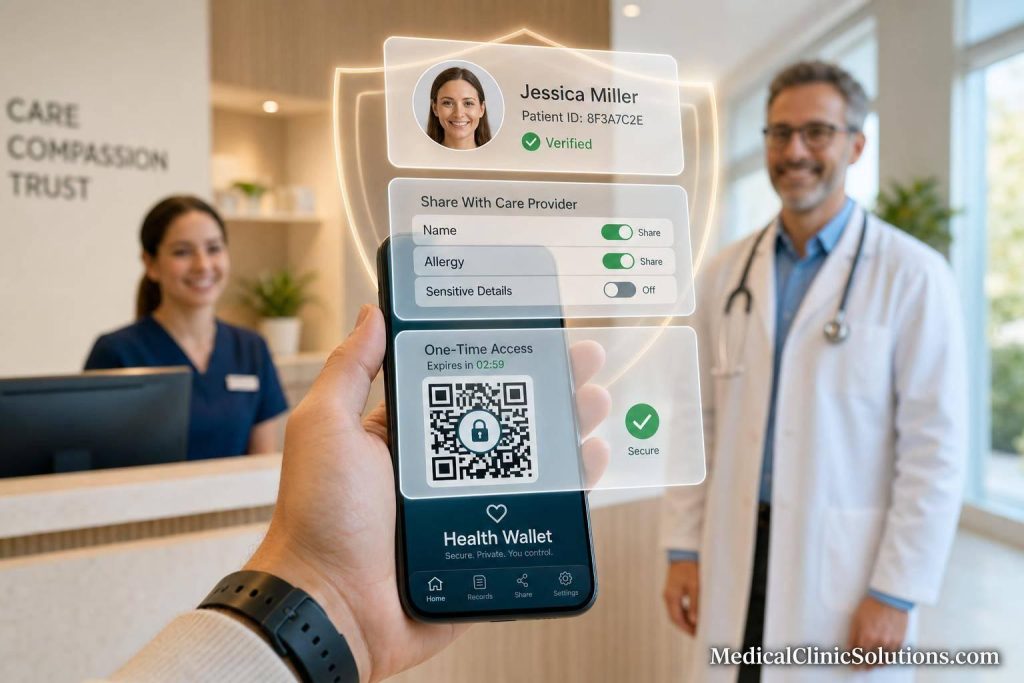
More than 70 million patient records were exposed in U.S. healthcare breaches in 2023. My takeaway is simple: decentralized identity helps cut patient data risk by letting people share proof instead of full records, tying access to cryptographic keys instead of passwords, limiting consent by purpose and time, and keeping raw PHI out of one big identity store.
If I had to sum up the whole article in a few lines, it would be this:
- Patients hold digital credentials in a wallet
- Clinics verify claims without copying full charts
- Selective disclosure supports HIPAA’s minimum necessary rule
- DIDs, verifiable credentials, and wallet apps work with current EHRs through APIs and HL7 FHIR
- Raw PHI should stay off-chain
- Rollout works best in registration, referrals, and staff credential checks
- Before launch, clinics need issuer rules, revocation steps, recovery plans, audit logs, and BAAs where needed
This model does not replace your EHR or portal. It adds an identity and consent layer that can reduce over-sharing, cut breach fallout, and give patients more control across clinics, labs, specialists, and telehealth.
| Area | What it does |
|---|---|
| Privacy | Shares only the claim needed |
| Access | Uses keys, not reused passwords |
| Consent | Limits access by time and purpose |
| Security | Avoids one central identity target |
| Compliance | Helps with HIPAA, Part 2, and audit review |
| Adoption | Fits best as a phased add-on, not a rip-and-replace project |
If you want the short answer: decentralized identity protects patient data by reducing how much information changes hands in the first place.
Josh Mandel – Decentralized Identity and FHIR | DevDays 2020 Virtual June
Core Concepts of Decentralized Identity in Healthcare
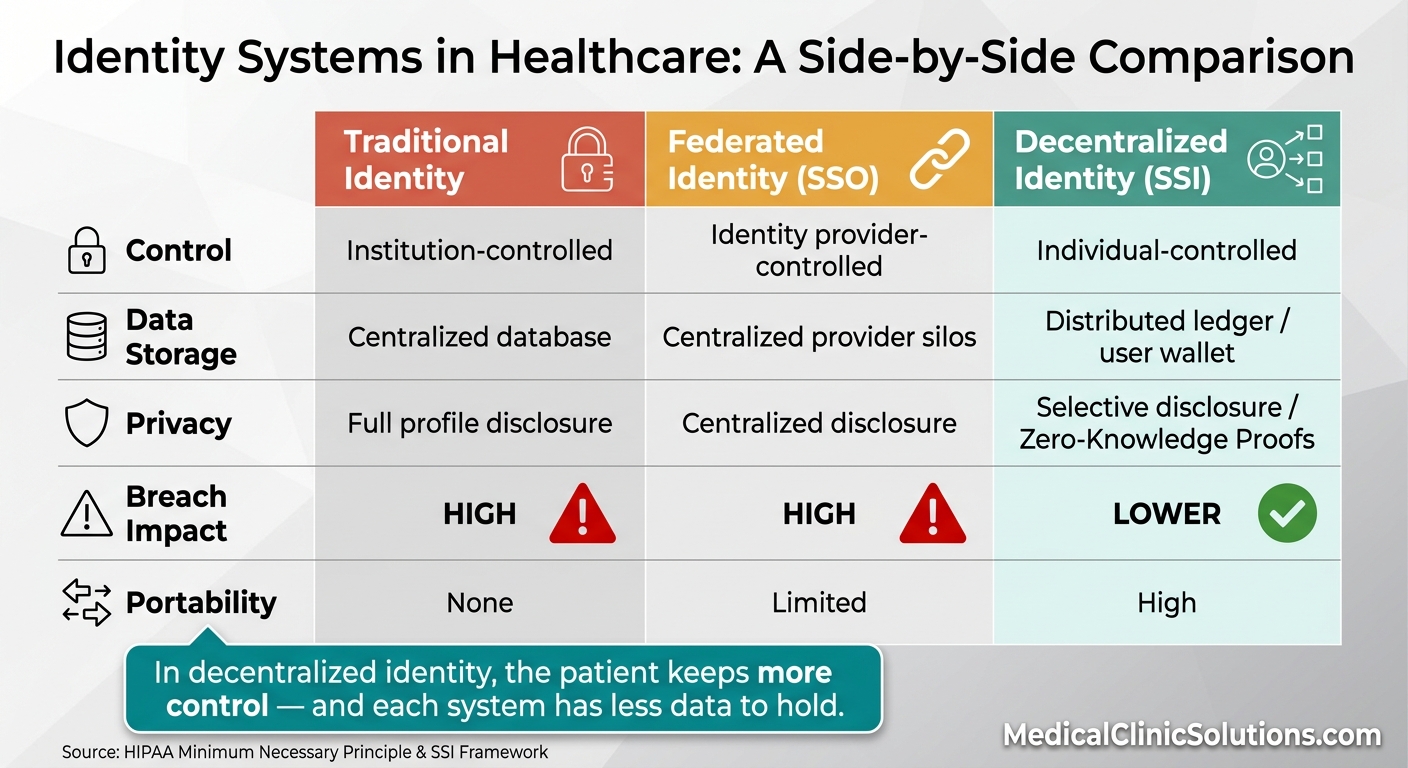
Decentralized vs. Traditional Identity Systems in Healthcare
Before digging into whether decentralized identity helps with security or compliance, it helps to get clear on the three parts that make it work: decentralized identifiers, verifiable credentials, and health wallets. Each one handles a different gap left by older identity systems.
Why does that matter in healthcare? Because these tools let providers verify who someone is without pulling in more data than the workflow calls for.
DIDs, Cryptographic Keys, and Pseudonymous Identifiers
A Decentralized Identifier (DID) is a unique identifier that does not depend on a central registration authority. In healthcare, DIDs are registered on a distributed ledger or blockchain.
DIDs work through public-private key cryptography. The private key stays with the patient or clinician in a wallet, while the public key is used to verify identity claims. That cuts dependence on static identifiers like Social Security numbers. And because a DID can be shared without PHI, it lowers exposure during identity verification.
Verifiable Credentials and Patient-Controlled Health Wallets
A Verifiable Credential (VC) is a digitally signed statement issued by a trusted entity, such as a hospital, insurer, or public health agency. In healthcare, VCs can represent insurance eligibility, immunization records, or professional licenses.
Patients keep these credentials in a health wallet, a user-controlled digital app that stores and presents credentials when needed. A health wallet can also store and revoke different credential types, including insurance, consent, and medication records.
That kind of selective disclosure lines up with HIPAA’s minimum necessary principle. Some systems also use zero-knowledge proofs to verify a claim without showing the data behind the claim. Think of it like proving you’re covered by insurance without handing over your whole file.
How Decentralized Identity Differs from Federated Login
Federated login, including many patient portal and single sign-on setups, still depends on a central identity provider that mediates access and stores identity data. Decentralized identity removes that middle layer and gives the patient more direct control.
For practices, the biggest gain is fewer centralized identity silos.
| Feature | Traditional Identity | Federated Identity (SSO) | Decentralized Identity (SSI) |
|---|---|---|---|
| Control | Institution-controlled | Identity provider-controlled | Individual-controlled |
| Data Storage | Centralized database | Centralized provider silos | Distributed ledger / user wallet |
| Privacy | Full profile disclosure | Centralized disclosure | Selective disclosure / ZKPs |
| Breach Impact | High | High | Lower |
| Portability | None | Limited | High |
The main difference comes down to where identity data lives. In centralized and federated systems, one party stores and manages most of it. In decentralized identity, the patient keeps more control, and each system has less data to hold.
That setup limits how much identity data any single system can store or expose. In healthcare, that can mean less PHI exposure across care settings.
How Decentralized Identity Protects Patient Data
These tools help protect data by limiting what gets shared, who gets in, and where data lives. But there’s a catch: DIDs, credentials, and wallets only do their job when teams use them to keep disclosure tight and restrict access to verified claims. In practice, decentralized identity protects patient data through four main controls: selective disclosure, cryptographic authentication, consent limits, and distributed storage.
Data Minimization and Selective Disclosure Cut PHI Exposure
A patient can present a signed claim – such as proof of insurance or immunization status – without exposing the full record behind it. That lines up with HIPAA’s minimum necessary principle. Instead of handing over an entire file, the patient shares only the piece that matters.
Zero-knowledge proofs push this even further. A patient can prove they meet an age threshold for a specific treatment without revealing their actual date of birth. The verifier gets proof that the requirement is met, and nothing more changes hands.
Cryptographic Authentication, Consent Controls, and Audit Trails
Passwords are weak. Cryptographic keys swap reusable secrets for patient-held credentials. That means access is tied to possession of the right key, not a password that can be guessed, reused, or stolen.
Patients can also grant time-limited, purpose-specific access and revoke it anytime. So a clinic, lab, or specialist doesn’t get open-ended permission by default. Access, consent, and data use can also be logged on a blockchain or distributed ledger, creating a tamper-evident audit trail that supports HIPAA reviews. Put together, these controls lower the risk of both credential theft and unauthorized access.
Lower Breach Impact and Better Privacy Across Care Settings
Centralized identity puts a lot of risk in one place. Decentralized identity reduces that risk by using patient-controlled Personal Data Stores (PDS) instead of a single institutional database. If one system is hit, it’s not automatically a jackpot for everything.
This setup can also support care across providers – primary care, specialists, labs, and telehealth – without relying on a central intermediary. Patients can use separate identifiers that can’t be easily linked across different care settings. That makes cross-system tracking much harder. Clinics also need clear revocation and reissuance procedures for lost or compromised wallets.
These protections map directly to the patient-data risks healthcare teams deal with most often.
| Patient Data Risk | Protection | Mechanism |
|---|---|---|
| Credential Theft | Cryptographic Authentication | Private keys replace passwords; biometric-bound |
| Over-sharing of PHI | Selective Disclosure | VCs and ZKPs share only required claims |
| Insider Misuse | Granular Consent & Audit Trails | Time-limited access keys; immutable logs |
| Centralized Breach | Distributed Storage | PHI in personal vaults, not one target |
| Unauthorized Long-Term Access | Dynamic Access Keys | Keys expire by use count or time window |
| Cross-System Tracking | Pseudonymous Identifiers | Separate, unlinkable DIDs per care setting |
U.S. Regulatory and Security Alignment
The security upside only matters if it fits HIPAA, medical clinic security systems, and other U.S. privacy rules in a clean, workable way. Decentralized identity can help with HIPAA, but it doesn’t replace the rest of the compliance program. You still need risk analysis, written policies, and Business Associate Agreements (BAAs).
How Decentralized Identity Supports HIPAA Safeguards
Decentralized identity lines up with each HIPAA safeguard category in direct ways. Smart contracts can enforce granular, time-limited access, along with emergency override rules. Immutable, timestamped ledgers can record every PHI access event. Cryptographic hashes can flag unauthorized changes to off-chain records.
DIDs and verifiable credentials also support strong, multi-party authentication. For transmission security, NIST-approved encryption and secure peer-to-peer exchange protocols can do the job. That said, if a service provider manages any part of that setup, a BAA is still required.
Consent Requirements, 42 CFR Part 2, and State Privacy Rules
The same selective disclosure model that cuts PHI exposure can also help with consent rules. Granular consent, fast revocation, and purpose limits can line up with HIPAA, 42 CFR Part 2, and state privacy rules.
Under 42 CFR Part 2, which covers substance use disorder records, patient-specific authorization is required, and revocations must reach all parties right away. Decentralized identity can support that by logging revocations on an immutable record so each participating entity gets the update.
State rules add another layer. California, for example, is moving toward standards that affect how digital wallets connect with state-held data.
Architecture Choices That Avoid New Compliance Risks
This only works if one design rule stays in place: keep raw PHI off-chain. Use the wallet and ledger for proofs and consent metadata, not for the clinical record itself. Clinical data should stay in your current regulated systems, while the blockchain handles tamper-evident hashes, indexes, and consent metadata. That lowers privacy risk and helps preserve HIPAA correction workflows.
Key management needs attention before launch. Use NIST-approved encryption, and protect keys in hardware-backed security modules (HSMs). Rotate those keys on a set schedule. You also need a clear revocation and re-issuance path for lost or compromised wallets before rolling them out to patients.
Any third-party wallet or identity provider should be checked for biometric binding support and alignment with NIST 800-63-4. And if that vendor handles PHI, a BAA must be in place.
The remaining question is where these controls fit into daily clinic workflows.
Putting Decentralized Identity to Work in Medical Practices
With the security model in place, the next step is simple: figure out where it fits into day-to-day clinic work.
Where Decentralized Identity Fits in Daily Clinic Operations
The best place to start is with the workflows that create the most identity friction: registration, referrals, and staff onboarding.
At registration, a patient can present a digital wallet with verified credentials, such as a government-issued ID and insurance card. Staff check the data once, and the practice can then issue a verified credential that the patient reuses across participating sites. That cuts down on repeated data collection and limits how much patient information each party gets to see.
Referrals are another strong fit. A patient can share only the specific data a specialist needs, like a medication list or immunization record, through direct secure exchange. Instead of handing over a full record, the patient shares just the relevant slice.
On the clinician side, DIDs can support Electronic Prescriptions for Controlled Substances (EPCS) verification and staff onboarding. That means a provider’s credentials can move with them across health systems without repeated proofing. Practices can also set up workflows that ask for only the minimum data needed at each step.
Once those use cases are defined, the next hurdle is governance and integration.
Governance, Interoperability, and Readiness for Adoption
Adoption depends on clear issuer trust rules, claim-specific access rules, and recovery steps for lost or outdated credentials. Before rollout, it helps to run a trust mapping exercise: trace each workflow where identity proofing now relies on a central directory, then flag which steps can accept outside credentials through APIs or middleware.
From there, document your approved issuer list and spell out which claims are needed at each touchpoint. Build and test revocation and recovery paths before a single patient wallet goes live. That prep work matters. If someone loses access to a wallet or a credential is no longer valid, staff need a path that’s clear and tested, not something figured out on the fly.
Integration usually calls for a verification layer that checks DID documents, credential signatures, and revocation signals at the point of use. In most practices, a phased rollout makes more sense than a hard switch. Running wallet-based exchange alongside legacy systems can limit disruption and give staff time to get used to the new process.
If those controls are handled well, decentralized identity can improve workflows without exposing more PHI than needed.
Conclusion: Key Takeaways for Medical Practices
Practices that begin with registration and referrals, then add revocation, recovery, and audit logging, can bring in decentralized identity without interrupting care. The compliance upside depends on tight governance and clean integration, with the early focus kept on trusted issuers, clear claim rules, and recovery workflows built before rollout.
FAQs
Is decentralized identity HIPAA compliant?
Yes, decentralized identity can support HIPAA compliance. But it doesn’t make a system compliant on its own.
Why? Because HIPAA is about more than good intentions. It comes down to how the system is built and managed day to day.
Decentralized identity fits well with HIPAA’s privacy and security goals because it can:
- limit data sharing to the minimum necessary
- create secure, auditable access logs
That said, compliance still depends on careful system design. You need strong encryption, secure credential management, and clearly defined access controls. Without those pieces in place, decentralized identity is just one part of the puzzle.
What happens if a patient loses their wallet?
If a patient loses their digital wallet, decentralized identity systems rely on recovery paths that are set up ahead of time. If credentials are lost or compromised, they can be securely revoked and tied back to the patient’s identity.
Because these systems don’t rely on a central authority, teams need to plan revocation and re-provisioning protocols in advance. That planning helps healthcare providers keep access to patient data secure while also protecting patient privacy.
Can decentralized identity work with my current EHR?
Yes. Decentralized identity is meant to sit on top of your current healthcare systems, not replace your EHR.
Many setups use standards like FHIR and APIs to link identity checks and data access with clinical software, including older health IT systems. Through Medical Clinic Solutions, practices can look at how these services might fit into day-to-day operations.