
Ultimate Guide to Denial Management and Coding Fixes

Key Takeaways:
- Claim Denials vs. Rejections: Denials occur after payer review; rejections happen before processing.
- Common Causes: Coding errors, missing modifiers, outdated codes, and administrative mistakes.
- Financial Impact: Denied claims cost $25–$118 to rework, with 65% never resubmitted.
- Prevention Strategies:
- Verify eligibility at scheduling and check-in.
- Use automated claims scrubbing tools to catch coding issues.
- Document medical necessity clearly to avoid denials.
- Resolution Tactics:
- Prioritize high-value claims with tight appeal deadlines.
- Assign specific denial types to appropriate team members.
- Track key metrics like denial rates and appeal success rates.
Stats to Know:
- 86% of denials are avoidable.
- Practices with denial management programs see a 20%–50% reduction in denial rates within a year.
- First-level appeals succeed 70%–80% of the time.
A structured denial management program, supported by the right tools and processes, can recover lost revenue and improve financial health.
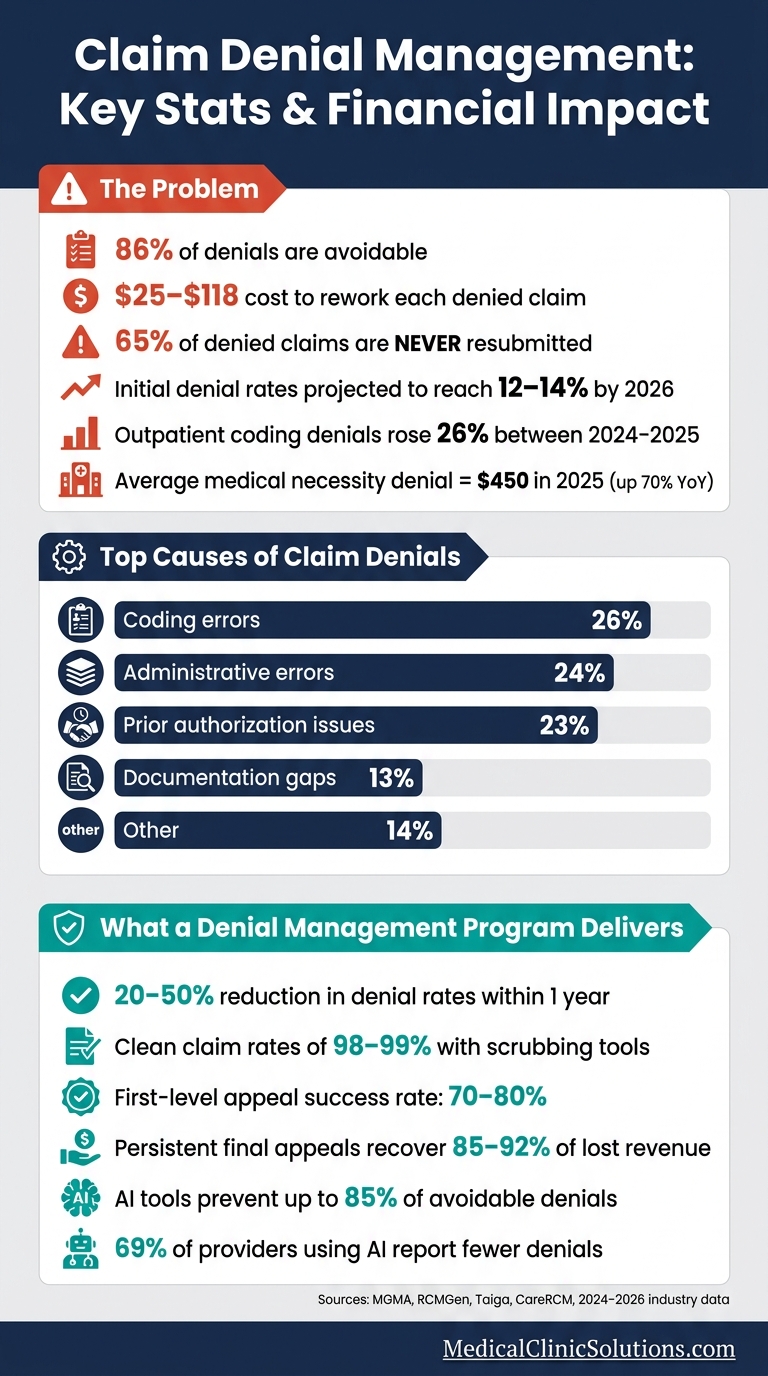
Claim Denial Management: Key Stats & Financial Impact
Common Claim Denial Categories and How to Fix Them
Common Types of Claim Denials
Understanding the different types of claim denials is key to addressing them effectively. Denials generally fall into three main categories, each with its own causes and solutions.
Administrative Denials
Administrative denials happen during the patient registration or scheduling process. These errors often involve inactive insurance coverage, incorrect subscriber IDs, or mismatched demographic details. Denial codes like CO-16 (missing or inaccurate claim information) and CO-22 (coordination of benefits error) are commonly associated with these issues. While these denials can typically be resolved by correcting and resubmitting the data, they are entirely avoidable. Despite this, administrative errors still make up about 24% of all denials.
"A denial is rarely a single error – it is the visible end of a process chain that broke earlier." – Safwan Azeem, Medical Billing and Coding Specialist
Although administrative errors are rooted in data inaccuracies, clinical denials require a completely different strategy.
Clinical and Medical Necessity Denials
Clinical denials arise when a payer determines that a service wasn’t medically appropriate for the documented diagnosis. These denials are often triggered by diagnosis codes that fail to support the billed service, incomplete physician notes, or not meeting a payer’s Local Coverage Determination (LCD) criteria. The financial impact of these denials is significant, with the average medical necessity denial amount hitting $450 in 2025, reflecting a 70% year-over-year increase. Reversing these denials usually involves filing a formal appeal, which requires the involvement of physicians, policy references, and detailed clinical documentation. As noted by Physicians Group Management (PGM): "Medical necessity denials are the most disputed category in medical billing, and also the hardest to reverse after the fact… you can’t build a medical necessity case retroactively."
Now, let’s look at how coding errors contribute to claim denials.
Coding and Billing Denials
Coding denials stem from technical mistakes in claims. These include issues like unbundling (billing separately for procedures that should be combined under NCCI edits), missing or incorrect modifiers (e.g., laterality modifiers like -59), and using outdated CPT or ICD-10 codes that don’t align with payer requirements. Denial codes such as CO-97 (service bundled into another) and CO-11 (diagnosis doesn’t support the procedure) are tied to these errors. Between 2024 and 2025, outpatient coding denials rose by 26%. While claims scrubbing tools can catch these errors early, unresolved issues can significantly delay claim processing. Unlike clinical denials, coding issues are usually resolved by correcting the errors and resubmitting the claim.
| Denial Code | What It Means | Category |
|---|---|---|
| CO-16 | Missing or inaccurate claim information | Administrative |
| CO-22 | Coordination of benefits error | Administrative |
| CO-29 | Timely filing limit exceeded | Administrative |
| CO-50 | Service not deemed medically necessary | Clinical |
| CO-11 | Diagnosis doesn’t support the procedure | Clinical/Coding |
| CO-97 | Service bundled into another procedure | Coding |
How to Build a Denial Management Program
A denial management program isn’t just about fixing rejected claims – it’s about creating a structured system to prevent revenue loss. As Taiga explains: "Most practices don’t have a denial management problem. They have a denial management framework problem." The key to success starts with capturing denials as they come in.
Setting Up a Denial Workflow
To streamline the process, consolidate all denials from ERA and EOB files into a single worklist. Relying on manual detection can leave up to 30% of denials unnoticed. Once captured, tag each denial with its CARC (Claim Adjustment Reason Code) and determine the internal root cause – whether it’s related to eligibility, authorization, coding, or documentation. This ensures the denial gets routed to the right person immediately.
Prioritize denials based on their dollar value and appeal deadlines. For instance, a $4,500 claim with only 30 days to appeal should take precedence over a $200 denial with a 90-day window. To handle resolutions effectively, use a three-lane system:
- Lane A: Quick fixes like simple corrections and resubmissions.
- Lane B: Denials requiring additional documentation.
- Lane C: Formal appeals that need clinical input.
Set clear Service Level Agreements (SLAs): for example, resolve soft denials within 5 business days and file hard appeals within 30 days. To close the loop, review root-cause data monthly and share insights with front-end teams to reduce recurring errors.
Metrics to Track Denial Management Performance
Tracking performance metrics is essential for improvement. Here’s a breakdown of key performance indicators (KPIs) and their industry benchmarks:
| KPI | Target Benchmark |
|---|---|
| Clean Claim Rate | 98%–99% |
| First-Pass Denial Rate | < 5% (best-in-class < 3%) |
| Final Denial Rate (after rework) | < 2% |
| Appeal Overturn Rate | > 60% overall |
| Days to Rework Soft Denial | < 5 business days |
| Denials Never Worked | 0% |
The "denials never worked" metric is particularly critical. Around 65% of denied claims are never resubmitted, meaning many practices unknowingly forfeit significant revenue. Monitoring this ensures accountability across the billing team.
Beyond metrics, assigning clear roles is essential for resolving denials efficiently.
Team Roles in Denial Management
Denial management works best when each type of denial is assigned to the team member closest to the source of the error. This saves time and improves resolution rates. Here’s how responsibilities can be divided:
| Root Cause | Responsible Team | Key Action |
|---|---|---|
| Eligibility / Demographics | Front Desk / Intake | Verify coverage 48 hours before the visit |
| Prior Authorization | Schedulers / Auth Team | Obtain and document authorization before the date of service |
| Coding / Modifiers | Certified Coders | Review NCCI edits and bundling rules |
| Medical Necessity | Clinicians | Provide clinical rationale and conduct peer-to-peer reviews |
| Timely Filing | Billers / AR Specialists | Submit clearinghouse timestamps as proof of timely filing |
In larger practices, a Clinical Documentation Improvement (CDI) Specialist can bridge the gap between clinical notes and billing requirements. By reviewing denial trends and updating documentation templates, they help reduce recurring errors. Additionally, a Denial Governance Council – a cross-functional team that meets monthly to review top denial reasons – can drive systemic improvements. For example, in 2026, one hospital system reduced sepsis-related DRG downgrades by 40% within six months by combining CDI education with standardized documentation checklists.
How to Fix Common Coding Errors
Correcting coding errors is a key part of an effective denial management program. With coding errors responsible for 26% of claim denials, they represent a major source of revenue loss. As initial denial rates are expected to rise to 12%–14% by 2026, getting coding right on the first try is more important than ever. The good news? Most coding errors follow predictable patterns, meaning they can often be addressed at the source.
Common Coding Errors and How to Fix Them
Many denials stem from a handful of recurring coding issues. For instance, missing or misused modifiers – like Modifier 25 and Modifier 59 – often attract scrutiny from payers. Modifier 25 requires documentation that clearly shows a distinct evaluation and management (E/M) service beyond routine pre- or post-operative care. Modifier 59 (or its more specific X-modifiers: XE, XS, XP, XU) must be backed by evidence of a distinct anatomical site or encounter. Using X-modifiers instead of Modifier 59 can provide clearer specificity.
Unbundling violations occur when two services are billed separately when they should be bundled into a single CPT code. These violations, flagged as CO-97, conflict with National Correct Coding Initiative (NCCI) edits. Another frequent issue, diagnosis-to-procedure mismatches (CO-11), happens when the ICD-10 code doesn’t logically support the billed procedure. This often results from coders opting for vague "unspecified" codes instead of more precise alternatives.
"In the era of ICD-10-CM specificity, ‘Unspecified’ is the new ‘Denied.’" – Rhode Island Medical Billing
Here’s a quick reference table mapping common denial codes to their causes and solutions:
| CARC Code | Meaning | Resolution Strategy |
|---|---|---|
| CO-4 | Modifier inconsistent with procedure | Ensure the modifier aligns with the CPT code and laterality requirements |
| CO-11 | Diagnosis inconsistent with procedure | Use a more specific ICD-10 code that supports the procedure |
| CO-50 | Not deemed medically necessary | Provide documentation with clinical rationale and LCD criteria |
| CO-97 | Payment included in another service | Confirm services were distinct; use Modifier 59 or X-modifiers if applicable |
| CO-151 | Level of service not supported | Include E/M evidence grids, MDM proof, or physician attestations |
Monthly E/M audits can help identify patterns of undercoding or miscoding early.
Documentation That Supports Appeals
Once coding errors are corrected, proper documentation becomes the backbone of successful appeals. Strong documentation must clearly explain why the service was medically necessary, connecting the clinical reasoning to the treatment provided. For example, instead of simply noting "knee pain", the record should specify, "failure of 6 weeks of NSAID therapy and physical therapy, necessitating MRI evaluation." This level of detail bridges the gap between symptom and service.
For chronic condition management, the MEAT protocol – Monitoring, Evaluating, Assessing, Treating – can be a helpful guide, especially for HCC risk adjustment coding. When appealing modifier-related denials, documentation must clearly demonstrate separate clinical logic, such as a distinct history of present illness (HPI), a different anatomical site, or a separate encounter.
When preparing an appeal packet, include:
- The original claim
- Clinical notes from the date of service
- Any prior authorization approvals
- A cover letter referencing the specific CARC code driving the denial
For medical necessity denials, peer-to-peer reviews are worth pursuing. These reviews can overturn decisions at rates as high as 75%, but most payers allow only a 14- to 30-day window from the denial date to request one. Set reminders for these deadlines to avoid missing opportunities.
Appeals can recover significant revenue. First-level appeals have a success rate of 70%–80%, while persistent final appeals can recover 85%–92% of revenue lost to coding errors.
Using Claims Scrubbing Tools to Catch Errors Early
Preventing errors before claims are submitted is the best way to avoid denials. Automated claims scrubbing tools can cross-check clinical notes against NCCI edits, payer-specific rules, and LCD/NCD criteria. These tools validate everything from technical details (like NPI numbers and demographic accuracy) to policy compliance and coding logic (e.g., modifier validity, MUE limits).
AI-powered scrubbers can detect errors before payer AI systems – which can flag and deny claims in under 60 seconds – get the chance. When paired with payer-specific edit rules, these tools can drive clean claim rates to 98%–99%, ensuring fewer denials and supporting overall revenue recovery goals.
How to Prevent Claim Denials Before They Happen
Reworking a denied claim costs about $118, and a staggering 65% of denials go unresolved. The better approach? Preventing denials in the first place. Around 60% of claim denials can be avoided, meaning most revenue loss doesn’t have to happen if you’ve got the right systems in place.
Front-End Prevention Steps
Denials often start long before a claim is even submitted. For example, missing or expired prior authorizations account for roughly 23% of denials, and registration errors only add to the issue. The solution begins at the front desk.
Eligibility verification should happen at three critical points: during scheduling, 24–48 hours before the appointment, and again at check-in. Automated batch tools can run eligibility checks overnight, flagging inactive coverage or plan changes before patients arrive. Scanning both sides of the insurance card at every visit can also help catch errors.
To avoid billing issues, use hard-stop controls in your practice management software to block claims without the necessary prior authorizations. With prior authorization requirements increasing by 30% over three years, it’s essential to have workflow controls that track authorization status, expiration dates, and CPT codes.
"Automating and bringing in health insurance verifications to our instance was a game changer. We have instant verifications for all of our prospects, as well as automated verifications for our clients on a weekly basis." – Teana Ellerbe, Director of Billing, VerifyTreatment
In May 2026, Foundation Recovery Network adopted the VerifyTreatment platform to automate insurance verifications. This change eliminated admission delays, reduced patient loss by 10%, and saved over $10,000 per month in previously lost revenue.
These front-end strategies create a solid foundation for efficient mid-cycle practices.
Mid-Cycle Coding and Documentation Practices
Once the patient is seen, accurate coding and documentation are critical for ensuring claims are approved. Coding mistakes cause about 26% of denials, while documentation gaps account for another 13%.
Start by documenting medical necessity instead of just symptoms. For instance, instead of writing "knee pain", include details like "failure of 6 weeks of NSAID therapy and physical therapy, necessitating MRI evaluation to rule out a meniscal tear". Same-day charge capture is another key step – documenting while the visit is fresh ensures Medical Decision Making (MDM) requirements are met and reduces the risk of missing billable details.
Regular internal audits can also help identify patterns before they become costly. Conducting monthly "mini-audits" of 10–15 high-value charts can flag issues like upcoding or unbundling early. For high-risk cases, such as sepsis or DRG-sensitive encounters, having a senior coder perform a second-level review can make a big difference. One hospital system that implemented targeted education and second-level reviews for specific DRGs reduced clinical validation denials for sepsis and respiratory failure by 40% in six months.
| Frequency | Action | Why It Matters |
|---|---|---|
| Daily | Same-day charge capture | Ensures MDM requirements are met while details are fresh |
| Weekly | Denial huddles (15 min) | Quickly addresses top rejection reasons |
| Monthly | Internal mini-audits | Spots upcoding or unbundling trends early |
| Quarterly | Payer policy review | Keeps EHR templates aligned with updated rules |
When denials do happen, back-end tools can help resolve them quickly.
Back-End Tools to Improve Resolution Rates
To complement proactive front-end and mid-cycle efforts, back-end tools are essential for efficient denial resolution.
Automated work queues that sort claims by CARC and RARC codes allow specialists to focus on specific denial types. Real-time dashboards and alerts for filing deadlines ensure claims stay within appeal windows.
AI-powered tools take it a step further by prioritizing denied claims based on dollar value and likelihood of overturn. In fact, 69% of healthcare providers using AI report fewer denials or better resubmission success. Automated scrubbing and predictive validation can even prevent up to 85% of avoidable denials.
"The providers who win on denial management ROI are not the ones who work denials hardest. They are the ones who build a system that prevents most denials, recovers the rest efficiently, and learns from every single one." – RCMGen
If you’re searching for tools to streamline these workflows – whether it’s claims scrubbing, eligibility verification, or billing automation – Medical Clinic Solutions connects practices with vetted billing services and software tailored to their needs.
Conclusion
Claim denials often result from system inefficiencies that can be addressed. With up to 90% of denials deemed preventable through improved front-end and mid-cycle processes, the financial impact of these losses highlights the importance of having a structured denial management strategy in place. The gap between lost revenue and recoverable revenue is exactly where a well-executed denial management program becomes essential.
Top-performing practices approach denial management as a core revenue strategy rather than a secondary billing issue. As CareRCM aptly states:
"The practices that collect the most aren’t always seeing the most patients. They’re the ones that treat denial management as an active revenue strategy, not a billing afterthought."
The foundation of effective revenue cycle management includes accurate coding, real-time eligibility checks, cross-functional collaboration, and automation powered by AI. Practices that excel in these areas often maintain denial rates under 5% and achieve first-pass resolution rates exceeding 90%. These outcomes are driven by tools working in harmony – such as claims scrubbing software, predictive denial detection, and automated prior authorization tracking. This integrated approach turns revenue cycle management into a competitive advantage.
If your practice still handles denials manually or relies on disconnected systems, the financial gap can be significant. By aligning your tools and processes as outlined here, Medical Clinic Solutions can help you optimize your revenue cycle, allowing you to focus less on chasing payments and more on delivering quality patient care.
FAQs
What should my first denial workflow look like?
The first step in creating an effective denial workflow is to focus on organization and prevention. Start by gathering all denials into a centralized queue. This queue should include:
- Assigned owners for each case
- Clear statuses to track progress
- Defined deadlines to ensure timely resolution
Next, categorize denials using CARC/RARC codes to pinpoint the reasons behind them. Investigate the root causes and route each denial to the appropriate team for resolution.
When prioritizing tasks, shift your focus to appeal deadlines instead of the dates the denials were received. This ensures that you’re addressing time-sensitive cases first. Lastly, analyze the outcomes of resolved denials to identify patterns and refine your front-end processes, helping to prevent similar issues from recurring.
Which denial KPIs matter most for a small practice?
For small practices, keeping an eye on key performance indicators (KPIs) is essential to maintain financial health. Here are a few metrics worth paying close attention to:
- Denial rate: This shows the percentage of claims denied on the first submission. Ideally, this should stay below 5%-7%.
- Appeal success rate: Helps measure how often denied claims are successfully recovered.
- Days in accounts receivable: Indicates how quickly payments are collected, giving insight into cash flow.
- Final denial write-off percentage: Reflects the revenue lost after all appeal efforts are exhausted.
These KPIs provide a clear picture of your practice’s financial performance and areas that might need improvement.
When should we appeal vs. correct and resubmit?
When deciding how to address a claim denial, it’s essential to understand the type of issue at hand. Rejections caused by technical mistakes – like typos or incomplete fields – can usually be fixed and resubmitted right away. For soft denials, such as those stemming from missing information or coding mistakes, resubmission is often possible without going through an appeal process. However, for adjudicated denials tied to policy concerns – like disputes over medical necessity – a formal appeal is typically required. Medical Clinic Solutions offers tools that can simplify these processes and help boost your claim approval rates.