
How Medical Transcription Improves Workflow Efficiency
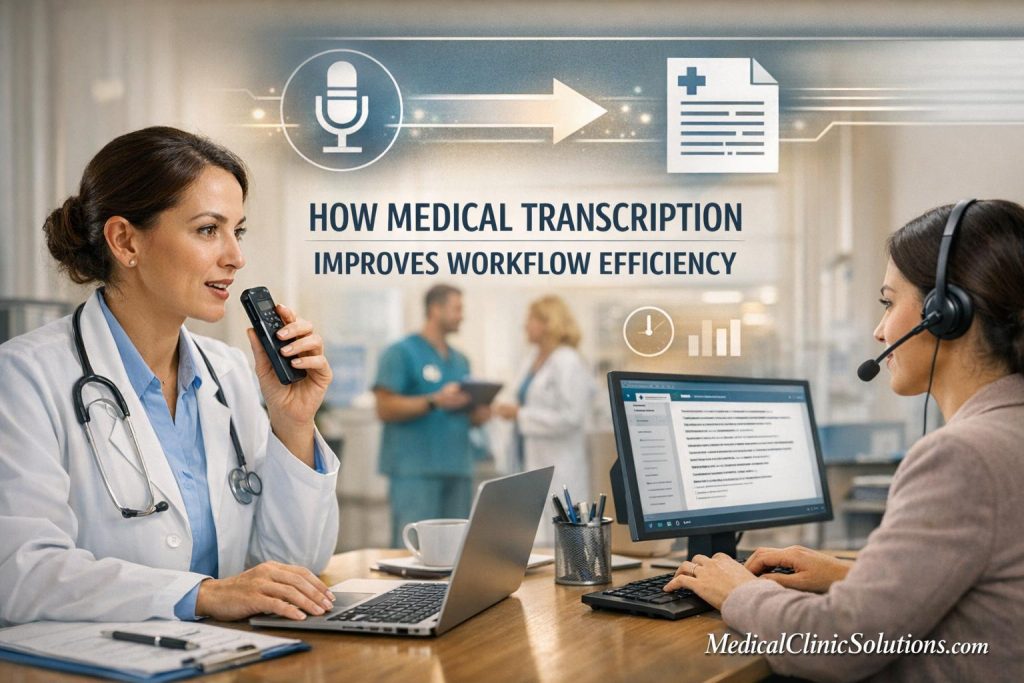
Medical transcription transforms how healthcare providers manage clinical documentation. By converting audio-recorded notes into structured medical records, it reduces the time spent on manual data entry, improves accuracy, and allows physicians to focus more on patient care. Here’s why it matters:
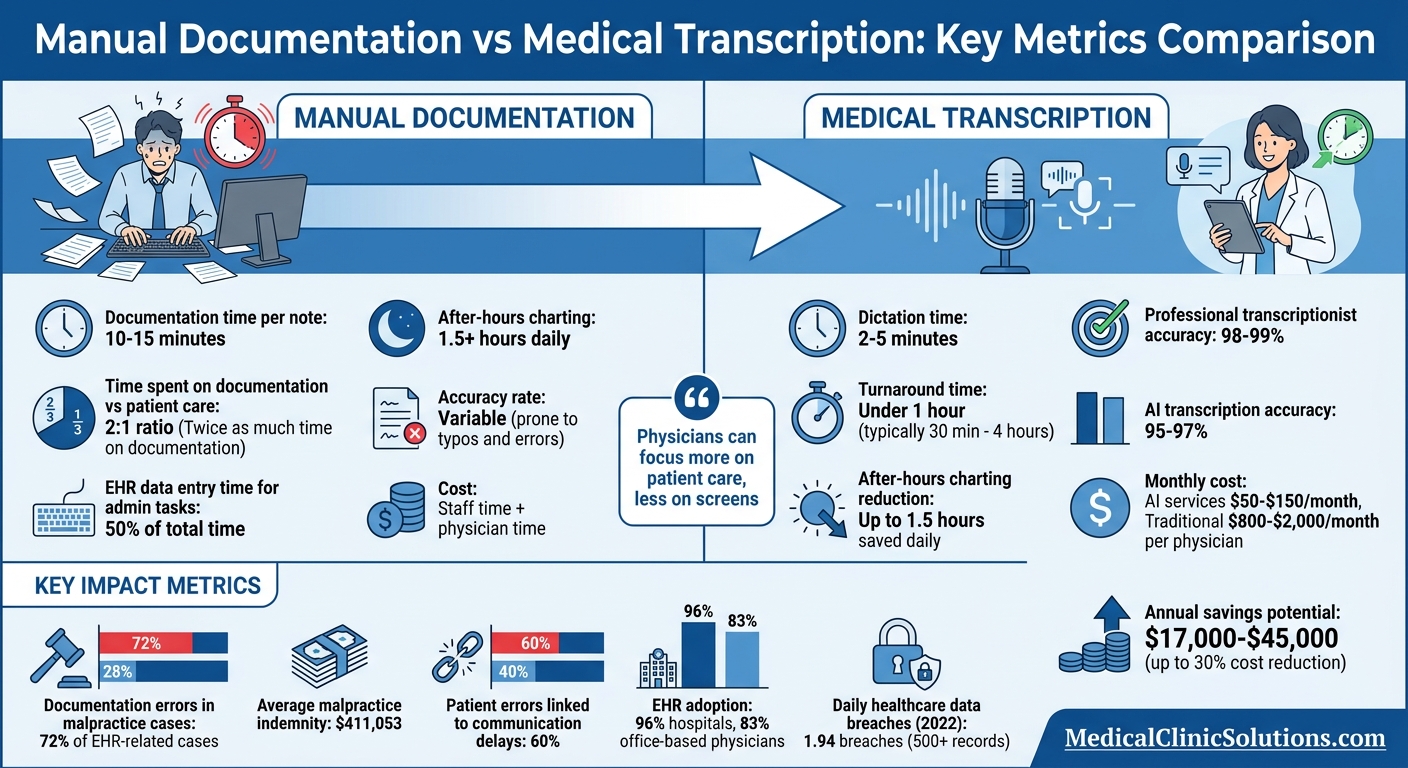
- Saves Time: Physicians spend less time typing and more time with patients. Dictation takes just 2–5 minutes, and notes are often ready in under an hour.
- Improves Accuracy: Professional transcriptionists achieve over 98% accuracy, reducing documentation errors that can lead to patient harm or malpractice claims.
- Reduces Burnout: Automated and team-based transcription services cut after-hours charting by up to 1.5 hours daily.
- EHR Integration: Modern transcription services seamlessly integrate with electronic health records, eliminating repetitive data entry.
- Affordable Options: AI transcription services cost as little as $50–$150 per month, making them a cost-effective solution for high-volume practices.
Medical transcription not only streamlines workflows but also enhances overall documentation quality and patient safety, making it a vital tool for healthcare providers.
Manual Documentation vs Medical Transcription: Time and Cost Comparison
Step 1: Cut Documentation Time with Medical Transcription
How to Choose and Implement Transcription Services
The first step is understanding your practice’s specific documentation needs. For instance, a neurosurgery practice, with its intricate operative reports, might require a different transcription setup than a primary care clinic focused on routine follow-ups. By assessing your documentation volume and the complexity of your specialty, you can decide whether to use human transcription for detailed cases, AI-powered services for high-volume routine notes, or a combination of both.
Security and compliance should be top priorities. Ensure the transcription provider offers a Business Associate Agreement (BAA) and uses 256-bit encryption to safeguard data both at rest and in transit. Compatibility with your existing electronic health record (EHR) system is also crucial. Look for integration options like HL7 interfaces, FHIR standards, or REST APIs to eliminate the need for manual data entry.
Next, choose a capture method that aligns with your workflow. Options include mobile apps, toll-free numbers, or digital recorders. Train your staff to dictate clearly, use standard punctuation, avoid shorthand, and produce high-quality recordings.
Before committing to a long-term contract, run a pilot test. This allows you to evaluate error rates and gather feedback from physicians. On average, AI transcription services deliver 95–97% accuracy, while human transcriptionists achieve 98–99%. Turnaround times also vary: human transcription typically takes 4–24 hours, whereas AI systems can process notes in as little as 30 minutes to 4 hours. A successful pilot test can set the stage for smoother workflows and significant time savings.
With a reliable transcription service in place, you’ll quickly notice how much faster and more efficient documentation becomes compared to traditional manual entry.
Manual Documentation vs. Transcription Services: Time Comparison
Transcription services offer a game-changing reduction in documentation time. Studies show that many physicians spend twice as much time on documentation as they do on direct patient care. Administrative tasks like clinical documentation and billing make up about 50% of total EHR data entry time.
By switching to transcription, physicians can focus on dictating rather than typing. Recording clinical notes typically takes just 2–5 minutes, and completed notes are usually returned in under an hour. This frees up hours that would otherwise be spent on keyboard work, allowing more time for patient interactions.
Cost is another factor to consider. Traditional transcription services can cost $800 to $2,000 per physician each month, while AI-powered options are much more affordable, ranging from $50 to $150 per month. When you account for the time saved and the potential for increased patient care, these services often pay for themselves by boosting productivity and reducing burnout.
Step 2: Improve Accuracy and Reduce Errors
How Trained Transcriptionists Deliver Better Accuracy
Professional transcriptionists bring a level of precision that automated systems simply can’t match. With a 99%+ accuracy rate, they rely on a thorough three-tier review process to catch missing details, inconsistencies, and terminology errors that could lead to serious issues. This meticulous approach ensures that even the smallest mistakes are addressed.
Errors in documentation can have serious financial and clinical implications. For instance, documentation mistakes account for 72% of reported EHR-related malpractice cases, with average indemnities reaching $411,053. Trained transcriptionists help avoid these costly outcomes by accurately distinguishing between similar medical terms, such as "ileum" and "ilium", which automated systems often confuse.
When it comes to reviewing AI-generated drafts, quality assurance is even more essential. AI systems still struggle with non-lexical conversational sounds like "mm-hm" or "uh-uh", showing a word error rate of 40%–57%. For clinically significant sounds, this error rate can skyrocket to 94.7%–98.7%. Professional transcriptionists bring a deep understanding of medical context, transforming spoken dictation into clear, structured records. By ensuring the use of proper terminology and avoiding ambiguous shorthand, they create documentation that is both precise and easy to understand. This level of accuracy, especially in real-time transcription, not only minimizes malpractice risks but also improves overall workflow efficiency.
Reducing Errors with Real-Time Transcription
Real-time transcription tools provide immediate updates to patient records during consultations, eliminating the need for after-hours documentation. This real-time approach captures details while they are fresh in the clinician’s mind, reducing the likelihood of mistakes like typos, misspellings, or incorrect data entry – common issues in traditional documentation methods.
The impact of real-time transcription is hard to ignore. 60% of patient errors are linked to communication delays or incomplete records. By documenting interactions as they occur, real-time tools prevent missed information and eliminate reliance on memory. When paired with human review, these transcripts achieve an impressive 98% or higher accuracy rate, compared to the 88% accuracy typically seen in automated-only systems. For critical records such as surgical reports or discharge summaries, human-reviewed transcription is the gold standard for ensuring precision and maintaining patient safety.
Step 3: Connect Transcription Services with EHR/EMR Systems
How EHR/EMR Integration Works
Modern transcription services are designed to integrate directly with electronic health records (EHR) using standardized protocols like HL7 (Health Level Seven) interfaces or FHIR (Fast Healthcare Interoperability Resources) protocols. This connection allows transcription data to auto-populate key EHR fields – such as HPI (History of Present Illness), Assessment, and Plan – making it instantly accessible for billing, analytics, and clinical use.
Here’s how it works: Physicians dictate their notes using a mobile app or handheld recorder. Professional transcriptionists then process and format the content, ensuring it flows seamlessly into the appropriate EHR sections. Once uploaded, providers can review and electronically sign the notes without ever leaving the EHR platform. This eliminates the need for manual data entry, saving time and reducing errors.
With nearly all hospitals (96%) and a large majority of office-based physicians (83%) now using EHR systems, having transcription services that integrate smoothly is no longer a luxury – it’s a necessity. These integrations also offer real-time updates, enabling clinicians to modify records directly within the system. For specialties that require detailed documentation – like oncology, cardiology, and orthopedics – this integration ensures comprehensive patient summaries are readily available, supporting continuity of care. Ultimately, this connection enhances the workflow by linking transcription directly to clinical decision-making.
How to Integrate Transcription Services with Your EHR/EMR
To start, confirm that your transcription service supports HL7 or FHIR standards to ensure compatibility with your EHR system. Before going live, test the integration in a sandbox environment to verify that notes populate the correct fields without errors.
It’s also important to standardize templates to align with your EHR’s structure. This step ensures consistency across records and complements other efficiency measures. To prevent errors, use multi-factor patient identification – such as matching both name and birthdate – before syncing transcripts.
Data security is critical during this process. Ensure your transcription partner uses HIPAA-compliant, encrypted data transfers and supports OAuth2 authentication for secure access. These measures protect sensitive information while maintaining detailed audit logs. Lastly, require physicians to review and finalize all transcribed notes electronically within the EHR. This step helps maintain patient safety and ensures the accuracy of documentation.
| Integration Component | Technical Standard | Purpose |
|---|---|---|
| Data Exchange | HL7 / FHIR | Facilitates standardized clinical data sharing |
| Security | OAuth2 / Encryption | Ensures secure data transfer and access |
| Data Entry | RTF / Structured Fields | Populates specific EHR sections (e.g., HPI, Plan) |
| Context Retrieval | Scheduling API / Webhooks | Pulls patient demographics and appointment details |
Step 4: Support Team Coordination and Compliance
Enabling HIPAA-Compliant Information Sharing
Medical transcription services play a crucial role in facilitating secure, HIPAA-compliant information sharing among healthcare teams. Providers’ dictated notes are transformed into standardized formats like SOAP (Subjective, Objective, Assessment, Plan), ensuring that all team members have access to consistent, clear documentation. This reduces confusion and helps improve clinical decision-making across departments.
To safeguard patient data, transcription services implement technical measures throughout the process. End-to-end encryption protects both audio and text files during transmission and storage, while role-based access controls (RBAC) ensure that team members can only view the data relevant to their roles. Additionally, every action – whether it’s accessing, editing, or sharing transcripts – is recorded in audit trails to meet regulatory standards.
The importance of these measures is underscored by data breaches in the healthcare sector. In 2022, an average of 1.94 breaches involving 500 or more records were reported daily. Julie Clements, a HIPAA Compliance Expert, emphasizes:
Maintaining patient privacy and confidentiality is a matter of medical ethics, fostering trust between patients, healthcare providers, and transcription companies, all of which is fundamental for quality care.
Before adopting any transcription service, ensure the vendor provides a signed Business Associate Agreement (BAA). This legally obligates the vendor to protect Protected Health Information (PHI) according to HIPAA standards.
| HIPAA Compliance Feature | How It Protects Patient Data |
|---|---|
| Audit Trails | Logs all actions, such as viewing, editing, and signing electronically |
| Encryption | Protects data during both transmission and storage |
| Access Controls | Limits access with unique user IDs and strong passwords |
| Automatic Deletion | Removes audio files within 24–48 hours to reduce PHI exposure |
By ensuring secure information sharing, transcription services naturally promote better team coordination, giving providers access to up-to-date and compliant records.
Improving Team Access to Patient Records
When transcription services integrate seamlessly with EHR systems, all care team members gain immediate access to the same updated information. This eliminates delays and reduces the risks associated with outdated records. A single patient’s care team often includes more than 10 members, such as doctors, nurses, and specialists.
Using standardized medical terminology is another key benefit. Clear, precise language prevents misunderstandings when specialists collaborate. For example, avoiding shorthand or vague phrasing ensures that a cardiologist can easily interpret notes from a primary care physician, or that an emergency room doctor can quickly review a patient’s history. Rajeev Rajagopal from a medical transcription service company highlights this point:
Clinical documentation should be clear and easily understandable by all healthcare professionals involved in a patient’s care. Ambiguous or vague language can lead to misinterpretation, affecting the quality of care.
Many transcription services provide reports within 12 to 24 hours, helping to avoid documentation backlogs that could slow down care coordination. Between 2020 and 2022, the number of individuals accessing their online medical records increased by 50%. This growing reliance on accurate, timely records underscores the importance of transcription services in supporting informed healthcare decisions for both providers and patients. Access to real-time, precise documentation enhances clinical workflows and decision-making processes across the board.
Step 5: Increase Productivity and Patient Care Quality
How to Evaluate Outsourced Transcription Services
When choosing a transcription service, focus on three key factors: accuracy, specialty expertise, and security compliance. For accuracy, the industry standard aims for 98% on major errors, while minor typos are generally acceptable. As Ben Walker, CEO of Transcription Outsourcing, puts it:
"Healthcare organizations ideally shoot for 98% accuracy for major errors. Minor errors are usually acceptable, so long as they are just typos or other less important things."
Additionally, ensure the provider has a solid grasp of medical terminology relevant to your specialty. Security is crucial, so verify that the service uses HIPAA-compliant platforms with encrypted data transmission and provides a signed Business Associate Agreement (BAA). Integration with your existing EHR/EMR system is another must-have, as it eliminates the need for manual data entry – a major time saver. Many providers even offer free trials, allowing you to test their accuracy and turnaround times before committing.
Cost considerations vary, with options ranging from pay-as-you-go plans to monthly subscriptions. Outsourcing transcription can cut costs by up to 30%, potentially saving practices anywhere between $17,000 and $45,000 annually. For high-volume practices, it’s worth negotiating for volume discounts or performance-based incentives tied to quality metrics.
Once you’ve chosen a provider and established quality benchmarks, the next step is to evaluate how these services enhance your overall workflow efficiency.
How to Measure Workflow Efficiency Improvements
To gauge the impact of outsourced transcription on your practice, track specific metrics that reflect workflow improvements. One of the most immediate benefits is time savings. Physicians often cut after-hours charting by about 1.5 hours per day, which can significantly ease burnout.
Another useful metric is clinical productivity, such as the number of patient visits per day. By using team-based documentation, providers can see more patients without compromising care quality. For example, in January 2026, Dr. Carlos Esparza’s clinic switched to an AI-powered transcription solution integrated with MacPractice. This change saved the clinic approximately $40,000 annually and reduced note review time to just one minute per patient. Dr. Esparza shared:
"Claio has been transformative. It has changed how I practice medicine by removing inefficiencies from my workflow and significantly reducing stress."
Similarly, in March 2026, Dr. Shelagh Fraser at Priority Physicians reduced her daily documentation time from 2–2.5 hours to just 40 minutes by adopting an AI scribe. Another clinic reported a 45% improvement in physician satisfaction scores after implementing automated documentation tools.
For tailored solutions that improve productivity and patient care, Medical Clinic Solutions connects U.S. medical professionals with transcription services designed to meet their specific needs.
Medical Transcription Analysis with Machine Learning
Conclusion
Medical transcription is reshaping clinical documentation by cutting out inefficiencies that consume so much of physicians’ time. Instead of spending nearly half their workday wrestling with clunky EHR systems, doctors can dictate naturally and rely on professional transcriptionists to handle the data entry. This shift removes a huge chunk of the administrative workload tied to EHR documentation.
The improvement in accuracy is just as impactful. Professional transcriptionists correct errors in about one out of every three dictations, ensuring records are more reliable. These time savings and accuracy improvements lay the groundwork for higher-quality patient care. And that matters – a lot – since documentation issues are linked to 72% of EHR-related malpractice cases. On top of that, integration capabilities seamlessly create unified digital records, eliminating the need for tedious manual copying and pasting.
But the benefits go beyond just saving time. By handing off documentation tasks, physicians can shift their attention from screens to their patients. As Bruno Campos, Deputy Director of Information Systems and Technologies at Luz Saude, puts it:
If the physicians cognitive bandwidth is used up just trying to get situational awareness… then physicians are not able to be the diagnostician and to generate trust with patients.
FAQs
Should I use AI transcription, human transcription, or both?
Combining AI transcription with human oversight creates a powerful approach to medical transcription. AI tools handle the heavy lifting by automating tasks like note-taking, saving time and effort. Meanwhile, human transcriptionists step in to ensure precision, particularly in more intricate or nuanced cases. This blend not only improves workflow efficiency but also minimizes errors, delivering consistently high-quality medical documentation.
How do I verify a transcription service is HIPAA-compliant?
To ensure HIPAA compliance, check that the transcription provider clearly states their commitment to following HIPAA regulations. Look for proof, such as third-party audits or certifications like SOC-2. It’s also important to request a signed confidentiality agreement, confirm they use secure workflows, and verify adherence to industry standards. Clear and detailed documentation of their compliance practices is crucial for safeguarding sensitive data.
What do I need to integrate transcription into my EHR?
To bring transcription into your EHR, start by selecting a trustworthy, high-accuracy transcription service that aligns with your workflow. Make sure the service securely transfers data into your EHR and complies with HIPAA regulations. It’s also essential to confirm compatibility with your EHR system and explore options for customizing workflows to improve efficiency. Effective integration depends on secure data handling, choosing a reliable service, and ensuring it works smoothly with your clinical operations for effortless documentation.