
ROI Study: AI Scribes in Medical Practices

AI scribes are transforming U.S. medical practices by reducing documentation time and increasing revenue. Physicians using these tools save up to 27 minutes daily on documentation and generate an additional $3,044 annually per physician. With over 80% of U.S. physicians now using AI scribes, the market is projected to grow from $600 million in 2025 to $3 billion by 2033.
Key takeaways:
- Time savings: Up to 40 minutes/day for primary care clinicians.
- Revenue boost: Additional 0.8 patient visits/week and 5.8% RVU increase.
- Costs: Subscription fees range from $49–$500/month, with setup costs for EHR integration.
- Challenges: Low adoption rates, payer scrutiny on high-complexity claims, and steep learning curves for new users.
While AI scribes reduce burnout and improve retention, achieving ROI depends on consistent use, proper training, and specialty-specific workflows. Practices should pilot tools and track metrics like time saved, revenue gains, and coding changes to ensure success.
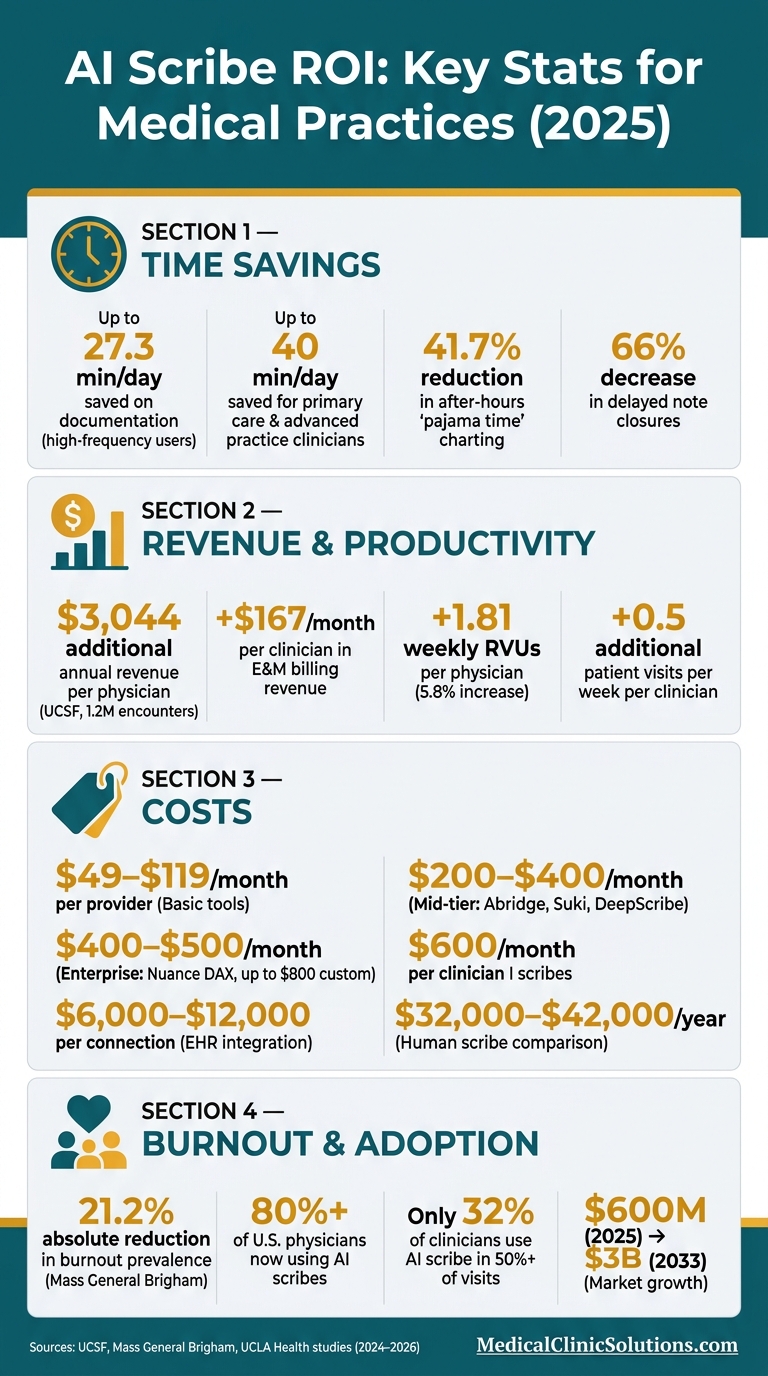
AI Scribe ROI: Key Stats for Medical Practices (2025)
The AI Scribe Revolution
Key Findings from Recent AI Scribe ROI Studies
Recent studies shed light on the financial and operational benefits of AI scribes, offering detailed insights into their impact on healthcare practices. While outcomes vary, the findings generally highlight positive trends.
Effects on Physician Productivity and Revenue
Detailed studies have quantified how AI scribes boost physician productivity and revenue.
One study from UCSF, which analyzed 1.2 million ambulatory encounters between January 2023 and April 2025, found that physicians using AI scribes generated 1.81 more weekly RVUs – a 5.8% increase. This translates into an estimated $3,044 in additional annual revenue per physician, based on 2025 Medicare rates.
Another multi-site study, involving 8,581 ambulatory clinicians across five major health systems, revealed that AI scribes contributed to an additional 0.5 patient visits per week per clinician. This increase added roughly $167 in monthly evaluation and management revenue per clinician.
"These findings provide initial evidence that AI scribes change how physicians code and bill, and may increase productivity and patient access to care." – A Jay Holmgren, PhD, MHI, Associate Chief for Research, UCSF Division of Clinical Informatics and Digital Transformation
Beyond revenue, these tools also help physicians save time on documentation, which can alleviate burnout.
Time Savings and Burnout Reduction
An April 2026 study by Mass General Brigham and UCSF examined 1,800 AI scribe users and 6,770 controls. It found that AI scribes reduced daily EHR usage by 13 minutes and documentation time by 16 minutes during an 8-hour shift.
Clinicians who used AI scribes in more than half of their encounters saw even greater time savings, with reductions of 21.3 minutes in total EHR time and 27.3 minutes in documentation time.
Challenges in Achieving ROI
Not all implementations of AI scribes yield strong financial returns. The multi-site study noted that while time savings were significant, the financial benefit of $167 per month per clinician might not fully cover the costs of these tools. Key factors influencing ROI include workflow integration, training, and adoption rates.
The data also suggest that clinicians who use AI scribes less frequently see smaller benefits. Interestingly, female clinicians, advanced practice providers, and primary care specialists reported the most notable improvements, emphasizing the importance of matching the technology to specific workflows and specialties.
"AI scribe technology is not just about going home a little bit earlier; it’s about how we are spending our days as clinicians." – Lisa Rotenstein, MD, UCSF
Financial ROI Models for AI Scribes
What AI Scribes Cost in US Clinics
The cost of AI scribes in the U.S. varies significantly based on the vendor and the level of integration with electronic health records (EHR). Most operate on a Software-as-a-Service (SaaS) model, with fees billed monthly or annually per provider. Basic tools designed for small practices range from $49–$119/month, while mid-tier platforms like Abridge ($250–$350/month), Suki ($300–$400/month), and DeepScribe ($200–$350/month) offer more advanced features. For enterprise-level solutions like Nuance DAX, with deep integration into systems like Epic or Cerner, costs can climb to $400–$500 per month per seat, with custom contracts sometimes reaching $800.
However, subscription fees tell only part of the story. EHR integration can cost between $6,000–$12,000 per connection, and training providers or redesigning workflows adds another $400–$800 per physician or $30,000–$60,000 for a 50-provider group. These upfront expenses are often underestimated but are crucial to include in ROI calculations.
Even at the higher price points, AI scribes remain far more affordable than human scribes, who cost $32,000–$42,000 annually, excluding benefits and training.
ROI Calculation Scenarios
To calculate ROI, four main components come into play: the subscription cost, revenue from additional patient visits, revenue from better coding (RVU increases), and savings from reduced clinician turnover.
Here’s an example using a primary care physician with a mid-tier AI scribe priced at $300/month:
| Variable | Conservative Estimate | High-Frequency User Estimate |
|---|---|---|
| Monthly subscription cost | $300 | $300 |
| Additional monthly revenue (visits) | $167 | Higher revenue likely |
| Weekly RVU increase | 5.8% (~$254/month) | 5.8% |
| Net monthly gain (revenue minus cost) | ~$121 | Substantially higher |
This example shows how even a small amount of time saved can quickly make up for the subscription cost. For instance, a family physician earning approximately $115/hour would see the tool pay for itself if it saves just 1.3 to 15.7 minutes per day, depending on the subscription tier. High-frequency users – those utilizing the tool in over 50% of visits – could save up to 27 minutes of documentation time daily, far exceeding the threshold for a positive ROI.
However, achieving these outcomes depends on proper implementation and consistent usage.
When AI Scribes May Not Deliver Positive ROI
While the potential for ROI is clear, several factors can disrupt these projections. The most significant issue is low adoption. Providers who use the tool infrequently experience only about one-third of the time savings compared to high-frequency users. For clinics paying for multiple licenses, underutilization can quickly erode the financial benefits.
Some specialties, such as surgical fields, may see little reduction in EHR-related tasks. Investing in an expensive enterprise solution for these groups without first piloting the technology could lead to financial losses.
Another challenge is payer downcoding. AI scribes often document visits in greater detail, leading to billing for more Level 4 and Level 5 visits. Insurers like Aetna and Cigna have started flagging these high-complexity claims, potentially reducing payments by around $50 per visit. As Mac Boyter, Senior Research Director at KLAS, explains:
"Every CIO I talk to… is saying, ‘Yeah, our clinicians love ambient tools. But I need to see the money. We need to see revenue generation or cost savings.’"
To mitigate these risks, clinics should pilot the tool before scaling. Start with 5–10 providers over 2–3 months, measure actual time savings, and monitor billing changes. For larger practices with 50 or more providers, negotiating lower licensing fees from the outset can also improve financial outcomes. Taking these precautions ensures that technology investments align with both financial and clinical objectives.
Operational and Clinical Benefits Beyond Financial ROI
Cutting After-Hours Charting and Documentation Load
One standout advantage of AI scribes is their ability to significantly reduce "pajama time" – the after-hours EHR work that eats into clinicians’ personal time. A study by Mass General Brigham, published in the Journal of General Internal Medicine in 2026, tracked 181 primary care clinicians across 14 practices over six months in 2024. By day 50 of using an ambient documentation tool, clinicians reported a 41.7% reduction in after-hours work and a 66% decrease in delayed note closures (notes left open for more than two business days).
However, the study also highlighted a 32.1% temporary increase in workload during the first 10 days as clinicians adjusted to the new tool. While this learning curve required some upfront effort, the benefits by day 50 were clear and measurable.
"Our findings directly inform ongoing efforts to deploy AI responsibly to improve clinician experience, reduce burnout, and enhance care delivery efficiency." – Lidia Moura, MD, PhD, MPH, Director of Population Health for the Department of Neurology, Mass General Brigham
These operational improvements not only save time but also play a critical role in reducing burnout and boosting clinician retention.
Improving Clinician Retention and Recruitment
Burnout among clinicians often leads to high turnover rates and gaps in patient care. AI scribes tackle one of the major contributors to burnout: the overwhelming documentation workload.
At UCLA Health, a randomized trial conducted between November 2024 and January 2025, led by Dr. Paul J. Lukac, studied 238 outpatient physicians from 14 specialties. Participants were assigned to use either Microsoft DAX Copilot, Nabla, or a control group. Both AI tools showed notable improvements in Mini-Z burnout scores, Physician Task Load (PTL), and Work Exhaustion scores compared to the control group. Nabla, in particular, reduced time spent on notes by 9.5%. Additionally, the Mass General Brigham study reported a 21.2% absolute reduction in burnout prevalence among clinicians using ambient AI documentation.
"Ambient artificial intelligence (AI) scribes… represent a promising solution to documentation burden and physician burnout." – Paul J. Lukac, MD, MBA, MS, University of California, Los Angeles
For clinics struggling with recruitment, offering AI-assisted documentation tools could serve as a compelling incentive – especially in primary care, where documentation demands are particularly heavy.
Better Documentation Quality and Compliance
AI scribes don’t just save time – they also improve the quality of clinical documentation. By producing more complete and detailed notes, AI tools help ensure accurate coding, particularly for higher evaluation and management (E/M) levels, which can positively impact revenue cycles.
Bobby DuPre, CMIO at FMOL Health, highlights this benefit:
"AI scribes, which have comprehensive, automatic documentation, may show that providers were doing higher complexity or longer visits that could be billed at Level 4 or 5."
When documentation fully captures the complexity of a visit – such as prescriptions, lab orders, and comorbidities – it supports accurate billing and reduces the chances of claim denials caused by incomplete or delayed notes.
Still, practices should keep a close eye on coding outlier rates. As mentioned earlier, insurers are scrutinizing high-complexity claims, making it essential to track approval rates for Level 4 and 5 visits to avoid potential payer issues.
How to Assess AI Scribe ROI for Your Practice
Key Metrics to Track for ROI
Before diving into AI scribe adoption, take a close look at your clinic’s current performance. Focus on three main areas: efficiency, productivity, and financial performance. These categories will help you establish a baseline and measure the impact of AI scribes over time.
| Metric Category | What to Track | Why It Matters |
|---|---|---|
| Efficiency | Daily EHR and documentation time (minutes) | Helps measure time saved with AI scribes |
| Productivity | Weekly patient visit volume | Tracks whether you’re seeing more patients |
| Financial | Monthly billing revenue per clinician | Monitors direct financial returns |
| Coding | E/M code distribution (Level 3 vs. Level 4/5) | Shows improvements in coding accuracy and complexity |
| Adoption | % of visits using AI scribe | Indicates whether you’re maximizing the tool’s potential |
Adoption rates play a huge role in realizing time savings. For example, clinicians using AI scribes in at least 50% of visits save an average of 21 minutes on EHR tasks and 27 minutes on documentation every day. However, only 32% of clinicians currently meet that threshold, which suggests there’s room for many practices to improve.
By tracking these metrics, you can compare your practice’s results with published research and identify areas for improvement.
Applying Study Findings to Your Clinic
While studies offer helpful benchmarks, they don’t always reflect the unique dynamics of your practice. Factors like specialty and payer mix can heavily influence your results.
- Specialty-Specific Savings: AI scribe benefits vary widely depending on the type of practice. For instance, primary care clinicians might save around 25 minutes of EHR time per day, while surgical specialists often see minimal time savings. Advanced practice clinicians (APCs), on the other hand, can save up to 40 minutes daily. This means practices with a surgical focus may experience different productivity gains compared to family or internal medicine clinics.
- Payer Mix Considerations: AI scribes often lead to higher-complexity billing, which could impact claim approval rates. Keep an eye on your current denial rates and monitor how payers respond to shifts in E/M coding.
A 12-week pilot program – split into 6 weeks before and 6 weeks after AI scribe adoption – can provide valuable insights. For example, Astera Cancer Care, a community oncology practice, tested the Knowtex AI scribe tool with 22 oncologists and 3 primary care physicians. With a high adoption rate (over 90% of visits), they saw average daily patient visits increase from 16.63 to 18.45, while daily revenue grew from $7,101.60 to $7,893.70. These results highlight the importance of achieving strong adoption from the start.
"Our study demonstrates the impact of AI scribes in diverse real-world implementations at multiple sites. Ease of use is key to achieving full benefits." – Lisa Rotenstein, MD, MBA, University of California, San Francisco
Tailoring these findings to your practice’s specifics will help you make a more accurate assessment of AI scribe ROI.
Using Educational Resources and Services
Once you’ve collected baseline metrics and completed a pilot program, external resources can help streamline your next steps. Evaluating AI scribe vendors can be daunting, especially for smaller practices. Platforms like Medical Clinic Solutions connect U.S. clinics with vetted software and service providers. They specialize in matching practices with tools that align with their specific workflows, EHR systems, and budgets. Using such services can save time and reduce the risk of choosing a solution that doesn’t fit your needs.
Conclusion: What AI Scribes Can Deliver for Medical Practices
The numbers speak for themselves: AI scribes can save time and money for medical practices, though the extent of these benefits depends on the practice’s specific circumstances. On average, clinicians save 13.4 minutes on EHR tasks and 16 minutes on documentation per shift. For primary care and advanced practice clinicians, the time savings can reach up to 40 minutes daily. Financially, the impact is also noticeable. A conservative estimate points to an additional $167 in monthly billing revenue per clinician. Meanwhile, a UCSF study analyzing 1.2 million ambulatory encounters found that AI scribes could generate an extra $3,044 annually per physician, based on projections for the 2025 Medicare Physician Fee Schedule.
However, these benefits hinge on regular, high-frequency use. Practices with low adoption rates tend to see much smaller returns.
"Health systems that view ambient AI scribes solely as revenue enablers may underestimate their strategic value and risk overlooking the human and organizational factors that drive sustained productivity." – Shreya J. Shah and Patricia Garcia, JAMA Network Open
This quote highlights a critical point: AI scribes are not just about boosting revenue. Their value lies in reducing the mental workload for clinicians, enhancing job satisfaction, and improving retention rates. Considering that physician turnover costs practices between $500,000 and $1 million in recruitment and lost productivity, even minor improvements in retention can translate into significant financial savings. Beyond the numbers, the long-term benefits for clinicians and organizations make AI scribes a compelling tool for modern medical practices.
FAQs
How do I calculate ROI for an AI scribe in my clinic?
To figure out the return on investment (ROI) for an AI scribe, you’ll need to evaluate a few key factors:
- Direct cost savings: How much can you save compared to your current documentation process?
- Revenue from reclaimed time: How many additional patient slots could you open up, and what’s the potential revenue from those visits?
- Coding improvements: Could better documentation lead to more accurate coding and higher reimbursements?
- Indirect savings: Consider benefits like reduced burnout and improved staff efficiency.
Start by calculating the total cost of your current documentation system. This includes not just the financial cost but also the time spent on documentation. Next, estimate the potential revenue growth. Multiply the number of additional patient slots you could handle by your average reimbursement rate. Be sure to factor in your payer mix and overall capacity.
If you need tailored guidance, Medical Clinic Solutions can connect you with tools and resources to help streamline this process.
What metrics should we track during an AI scribe pilot?
When assessing the impact of an AI scribe pilot, it’s essential to focus on three areas: financial performance, operational efficiency, and provider well-being. Here’s a breakdown of the key metrics to monitor:
- Financial Metrics: Pay attention to changes in billed work RVUs (Relative Value Units), the accuracy of evaluation and management coding, and any revenue growth tied to increased patient visits. These indicators can help you understand the financial benefits of the AI scribe.
- Operational Metrics: Measure how the AI scribe affects day-to-day workflows. Key data points include time spent in the EHR (Electronic Health Record), documentation time per patient encounter, and the percentage of notes completed within 24 hours. These metrics reveal how the tool impacts efficiency.
- Provider Well-Being: To gauge the scribe’s effect on burnout, track after-hours work (often referred to as "pajama time"), adoption rates among providers, and patient satisfaction scores. Together, these provide a fuller picture of how the scribe influences both providers and patient experiences.
By keeping an eye on these metrics, you’ll gain a clear understanding of the AI scribe’s overall value and effectiveness.
Will AI scribe notes increase audit or downcoding risk?
The results are a bit of a mixed bag. One study showed no noticeable rise in billing denials, note length, or the percentage of notes closed within 24 hours. It also highlighted a reduction in documentation time and a slight increase in RVUs (Relative Value Units). On the flip side, some analyses hint that AI scribing could lead to higher coding intensity by capturing more detailed documentation. This might increase the risk of upcoding or downcoding if appropriate safeguards aren’t implemented.