
Best Practices for Incentivizing Patient Referrals
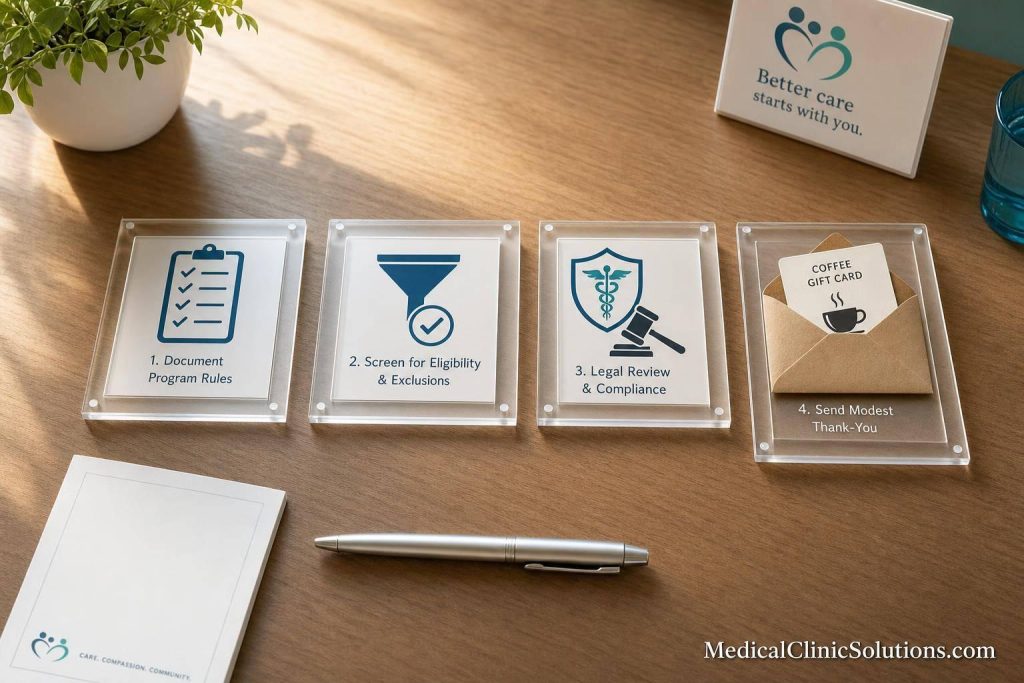
If you want more patient referrals in the U.S., the safest move is simple: keep rewards small, non-cash, and outside federal program patients.
I’d sum it up like this: referral programs in healthcare are not like referral programs in retail or fitness. A gift card, cash payment, or percent-based reward can create legal trouble under the Anti-Kickback Statute, patient inducement rules, state fee-splitting laws, and HIPAA-related privacy issues. On top of that, the AMA says physicians should not pay current patients to recruit other patients.
Here’s the short version:
- Do not offer cash or gift cards
- Do not tie rewards to insured services
- Exclude Medicare, Medicaid, TRICARE, and CHIP patients from reward eligibility
- Use low-dollar thank-you items or simple recognition instead
- Limit any credit to self-pay, non-covered services
- Put the policy in writing and have counsel review it before launch
In most cases, the lower-risk options are:
- a handwritten thank-you note
- a verbal thank-you
- low-cost branded items, often around $8 to $20
- a small charity donation in the patient’s name
- a self-pay service credit, often around $25 to $50, only where state law allows it
The biggest risk points are pretty clear. Federal law bars offering “anything of value” to induce referrals tied to Medicare or Medicaid-covered care. State law may go even farther, including in private-pay settings. And if your staff can’t track who referred whom, when the visit happened, and whether the patient was eligible, the program can get messy fast.
My takeaway: if a referral program feels like a sales commission, it’s probably the wrong fit for a medical practice. If it looks like a modest thank-you, is limited by written rules, and is reviewed for legal compliance, it is much more likely to stay on safer ground.
To keep it simple, I’d focus on three things: trust, written rules, and clean tracking.
Med Spa Referral Program: How to Create Compliant Patient Reward Programs
Legal and Ethical Rules That Should Shape Every Referral Program
Before you build any referral program, you need a clear view of the rules around it. Those rules come from federal law, medical ethics, and state regulations. The point isn’t to ban every thank-you. It’s to make sure any reward stays small, neutral, and lawful.
Federal Fraud and Inducement Rules That Limit Referral Payments
The Anti-Kickback Statute (AKS) is the main federal limit on referral rewards tied to Medicare and Medicaid-covered services. It bans paying or offering anything of value to induce referrals. In plain terms, the reward itself is only part of the issue. The patient’s insurance status matters too.
The Beneficiary Inducements Civil Monetary Penalties (CMP) Law also puts limits on what providers can offer. It prohibits gifts or inducements to Medicare or Medicaid beneficiaries when those offers are likely to affect provider choice. So if a patient reward is tied to someone in a federal health program, the risk goes up fast.
Stark Law deals with physician self-referrals for designated health services. If a financial relationship exists, those referrals are barred unless an exception applies.
HIPAA comes into play anytime referral tracking or follow-up uses protected health information. It also limits marketing uses of that information unless the patient has given authorization.
AMA Ethics Guidance and State Law Restrictions
Even if a program avoids a federal penalty, it can still cross an ethical line. The AMA Code of Medical Ethics is direct on this point:
"Physicians must not offer financial incentives or other valuable incentives to current patients in exchange for recruitment of other patients. Such incentives can distort the information patients provide and skew the expectations of prospective patients, thus compromising the trust that is the foundation of patient-physician relationships." – AMA Code of Medical Ethics
That guidance applies whether federal funds are involved or not. The AMA’s concern goes beyond legal exposure. It’s about protecting trust in the physician-patient relationship.
State law can be stricter than federal law. California, for example, limits referral payments even in private-pay settings, and many states also ban fee-splitting with non-licensed referrers. That leaves a pretty narrow lane for low-risk programs, which the next section breaks down.
U.S. Referral Incentive Rules at a Glance: Comparison Table
| Law/Ethical Source | What It Regulates | Key Restriction on Incentives | Typical Impact on Patient Referral Programs |
|---|---|---|---|
| Anti-Kickback Statute (AKS) | Medicare/Medicaid referrals | Bans any payment or reward to induce referrals | Exclude federal beneficiaries from reward eligibility |
| Beneficiary Inducements CMP | Patient choice of provider | Prohibits incentives likely to affect provider selection | Limits reward value and type for Medicare/Medicaid patients |
| Stark Law | Physician self-referrals for designated health services | Bars referrals where a financial relationship exists without an exception | Restricts ownership-based referral and compensation structures |
| HIPAA | Patient data and privacy (PHI) | Restricts marketing use of patient data without authorization | Requires secure tracking; limits third-party data sharing |
| AMA Ethics Guidance | Professional conduct of physicians | Discourages financial incentives for patient recruitment | Shifts programs toward non-incentivized appreciation |
| State Laws (e.g., California B&P Code 650) | General medical practice, including private pay | May ban referral payments regardless of insurance type | Makes cash-equivalent rewards risky even in private-pay practices |
These rules cut down the list of safe options. The next section separates low-risk recognition from tactics that can trigger compliance problems.
Low-Risk Incentive Models and High-Risk Tactics to Avoid
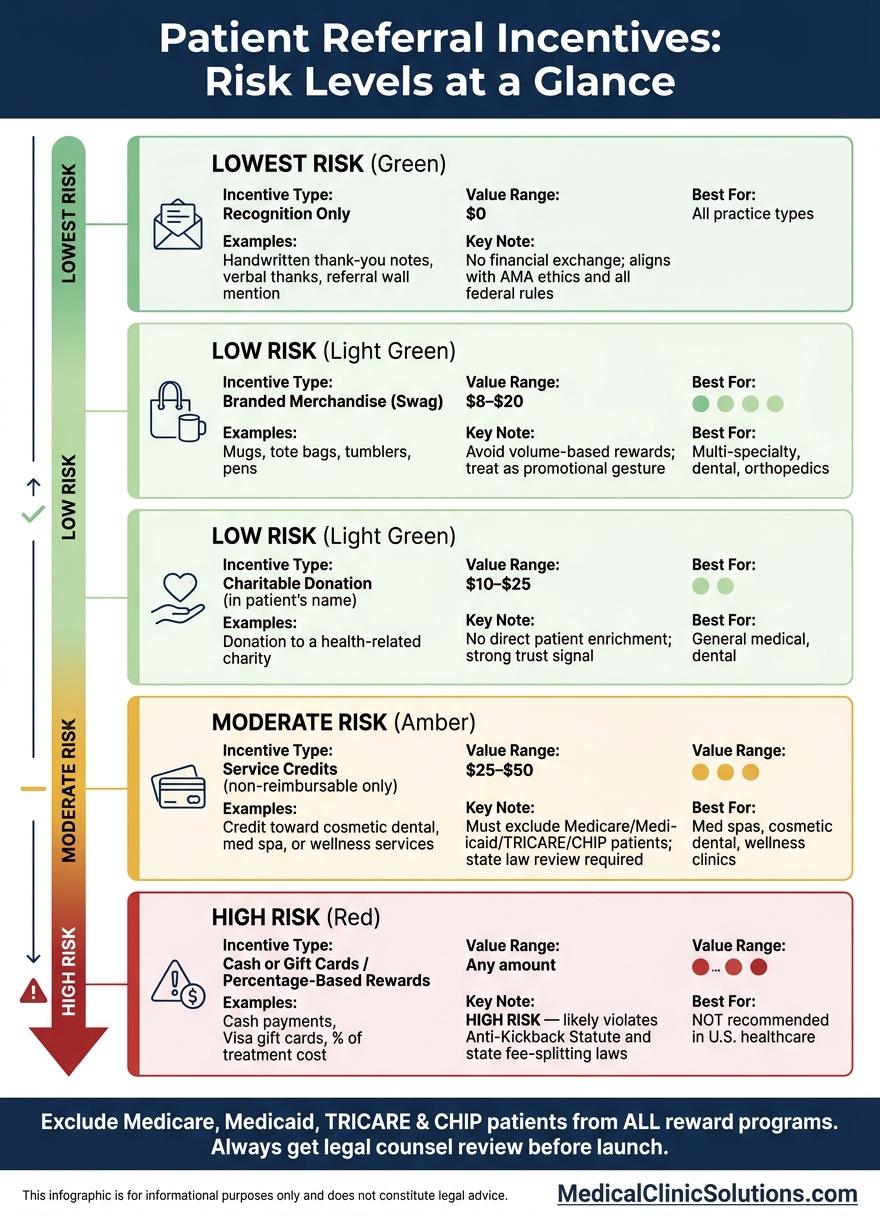
Patient Referral Incentives: Low-Risk vs. High-Risk Options for Medical Practices
Recognition-First Approaches That Protect Patient Trust
As cash value goes up, legal risk tends to go up with it. That’s why the safest programs lean on noncash, appreciation-based gestures.
Start simple. A handwritten note, a brief verbal thank-you, or a mention on a referral wall tends to be the lowest-risk path. These options show gratitude without turning a referral into a money-driven decision.
Another lower-risk path is a small donation to a health-related charity in the referring patient’s name. That can strengthen trust and avoids putting money or direct perks in the patient’s pocket. Branded merchandise sits a little farther along the spectrum, but it’s still usually seen as a promo gesture rather than payment. Think ceramic mugs, canvas tote bags, or pens, often in the $8–$20 range.
In practice, patients often react better to sincere thanks than to small cash-like rewards.
If a practice offers anything with monetary value, keep it modest and limit it to cash-pay services.
When Discounts, Credits, or Gifts May Be Considered
Private-pay settings, such as med spas and cosmetic dental practices, usually have more room to work with because the reward is not tied to services billed to federal programs. In those cases, a service credit in the $25–$50 range for cash-pay services or products, like teeth whitening or skincare, is often a lower-risk option.
The big line to watch is what the credit covers. Discounts on insured services are high risk. A credit for a cosmetic, non-insured service is a different setup. Still, California’s Business and Professions Code 650 and similar state laws can limit these programs, so legal review before launch is a must.
No matter the practice type, two tactics should stay off the table:
- Cash or gift cards
- Percentage-based rewards tied to treatment cost
Both bring high risk. Cash and gift cards can be viewed as inducements under the Anti-Kickback Statute, while percentage-based rewards can run into state fee-splitting bans.
Incentive Types, Value Ranges, and Compliance Concerns: Comparison Table
| Incentive Type | Approx. Typical Value Range | Compliance Considerations | Best-Fit Practice Types |
|---|---|---|---|
| Recognition Only (notes, verbal, wall) | $0 | Safest option; no financial exchange; aligns with all ethical codes | All practice types |
| Branded Swag (mugs, totes, tumblers) | $8–$20 | Low risk; avoid volume-based rewards | Multi-specialty, dental, orthopedics |
| Charitable Donations | $10–$25 | Low risk; no direct patient enrichment; strong trust signal | General medical, dental |
| Service Credits (non-reimbursable only) | $25–$50 | Moderate risk; must be for non-reimbursable services; exclude federal patients | Med spas, cosmetic dental, wellness |
| Cash / Gift Cards | Any amount | High risk; often violates AKS and state fee-splitting laws | Not recommended in U.S. healthcare |
Once you pick the incentive model, document it and track it the same way every time. Then spell out who qualifies, what triggers the reward, and how staff should log it before the program goes live.
How to Build and Run a Referral Program Inside Your Practice
Set Clear Eligibility, Trigger Events, and Written Terms
Once you pick the incentive model, put the whole thing into a written workflow. That matters more than it may seem. A referral program falls apart fast when staff members explain it one way, patients hear it another way, and nobody can point to the actual rules.
Start with eligibility. Be specific from day one. Medicare, Medicaid, TRICARE, and CHIP patients should be excluded from reward eligibility. You should also define what counts as a valid referral in plain language. For example, that may mean a patient who has not been seen in the past 2 to 3 years.
Next, decide exactly when the reward goes out. Tie it to a clear event, such as the referred patient completing their first appointment or making a payment for a cash-pay service. Do not issue a reward before care is delivered. After that trigger happens, send the reward within 1 week.
Put the full policy in writing, including:
- eligible participants
- trigger events
- reward limits
- expiration dates
Then review those terms with counsel.
Track Referrals with Intake Fields, Codes, and Software
If you don’t track referrals well, the program becomes guesswork. You can’t confirm eligibility, send rewards the right way, or see whether the program is paying off.
At a basic level, the system needs one required Referral Source field on the intake form and in the EHR or practice management system. Front-desk staff should be trained to collect the specific referrer both at booking and at check-in. That means recording the actual person’s name, not vague notes like "a friend." Digital referral links or QR codes can make attribution easier.
For HIPAA compliance, enter addresses directly into the fulfillment portal instead of uploading bulk patient lists to third-party vendors.
Controls That Reduce Errors and Risk: Comparison Table
Use these controls to keep the program consistent and auditable.
| Operational Element | Concrete Practice | Risk If Missing | Metric to Monitor |
|---|---|---|---|
| Written Policy | Written criteria for valid referrals and eligibility | Legal exposure, including AKS risk, and disputed reward payments | Annual compliance review completion |
| Staff Training | Scripted asks at booking and check-in, plus training on ethical boundaries | Documentation gaps and missed referral opportunities | % of new patients with the source field completed |
| Referral Attribution | Mandatory intake fields and unique digital links or QR codes | Duplicate rewards and inaccurate ROI data | Referral-to-appointment conversion rate |
| Reward Accuracy | Credits applied only to non-reimbursable services, with automated triggers after visit completion | Billing conflicts and overpayments to no-shows | Reward-to-completed-visit ratio |
| Follow-Up Timing | Automated alerts when a referred patient completes their first clinical encounter | Referrers feel ignored and participation drops | Average days between referral visit and thank-you sent |
Conclusion: More Referrals Start with Trust, Documentation, and Compliance Review
A referral program can help grow a practice, but it only works when it’s built on trust, clear rules, and steady recordkeeping. The key issue isn’t just whether the program brings in more patients. It’s whether the program can stay compliant.
Federal fraud rules and stricter state laws can lead to serious penalties, so compliance needs to come first.
Keep any incentive modest, non-cash, and limited to the patient groups allowed under your written policy.
Have healthcare counsel approve the program. Then document the rules, train staff, and track every referral source in your EHR or practice management system. Trust, documentation, and legal review help keep the program defensible.
FAQs
Can I reward referrals if patients have private insurance?
Yes, but you need to be careful.
Federal laws like the Anti-Kickback Statute mainly focus on referrals tied to Medicare and Medicaid. But state laws can go further. In some states, referral rewards may be banned even when the patient has private insurance or pays out of pocket.
The AMA also views paid referrals as unethical.
To lower risk, keep any reward modest, tied to a service, and non-cash. Before you roll out a program, have legal counsel review it.
What counts as a low-risk patient referral incentive?
A low-risk patient referral incentive should stay modest and tied to services, not cash or gift cards. To reduce compliance risk – especially under the federal Anti-Kickback Statute – these programs should leave out patients covered by federal programs like Medicare or Medicaid.
A few common examples include small discounts on non-insured services, discounts on higher-margin services, and branded practice merchandise.
The framing matters too. These rewards should come across as a consistent thank-you, not a quid pro quo for sending someone in. Before anything goes live, legal counsel should review the program.
How should my practice track referrals compliantly?
Keep organized records that show due diligence and medical necessity – not financial gain. Use a HIPAA-compliant CRM or an integrated EHR system to securely log referral sources, dates, patient statuses, and outcomes.
Track referral volume and conversion rates to spot trends, but don’t use that data to reward referrals in ways that break the Anti-Kickback Statute or Stark Law. It also helps to audit your process on a regular basis and check in with a compliance officer or healthcare attorney.