
Smart Contracts for Patient Data Access: Guide

Smart contracts can help control access to patient data, but they do not replace HIPAA duties. Keep clinical records off-chain, have the EHR enforce access limits, and test whether revoking permission stops future access.
For U.S. practices, the buying decision comes down to five checks:
- Consent and identity: Verify who is requesting records, the legal basis for sharing them, and any added restrictions.
- EHR connections: Confirm that interfaces and scoped tokens limit which records can be retrieved.
- Access logs: Track permission decisions separately from records viewed, downloaded, or exported.
- Security and downtime: Test key recovery, emergency access, outages, and contract updates.
- Vendor fit and cost: Review HIPAA responsibilities, production use, integration fees, support, and exit costs.
The goal is simple: choose a system that enforces access rules across the full workflow – not just on the ledger.
Bringing Trust and Privacy-Preserving Smart Contracts to Clinical Tri… Andrew Weiss & Bruno Vavala
Patient Consent and Access Decisions
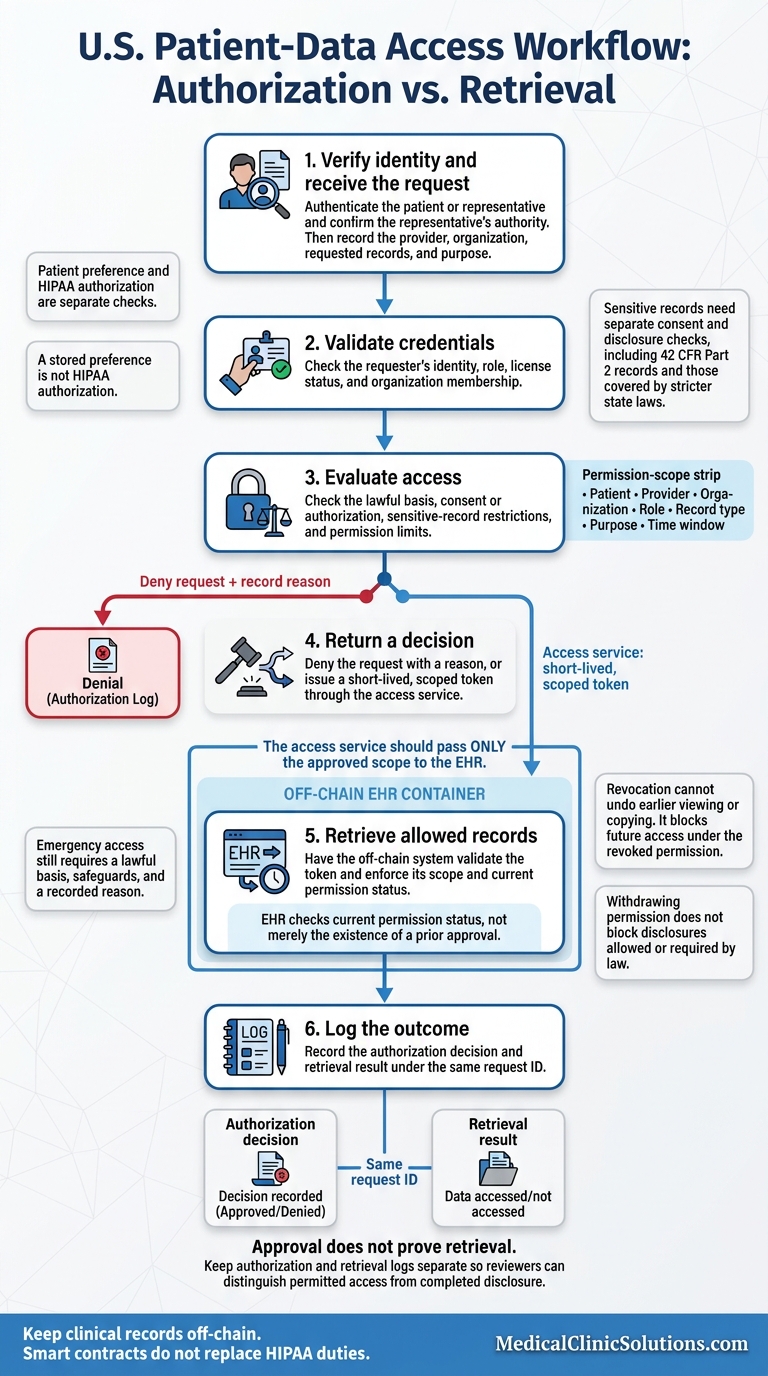
Patient Data Access: From Identity Checks to EHR Retrieval
Patient preference and HIPAA authorization are separate checks. A stored preference is not HIPAA authorization. Access rules must establish a lawful basis for disclosure – such as treatment, payment, or health care operations where permitted – and apply any added restrictions. Withdrawing permission does not block disclosures allowed or required by law. Once the lawful basis is established, the contract can decide whether to allow access.
Before giving a representative access, check any limits tied to the records. Sensitive records need separate consent and disclosure checks, including 42 CFR Part 2 records and those covered by stricter state laws.
Permission Limits, Revocation, and Emergency Access
Define each permission by patient, provider, organization, role, record type, purpose, and time window. Combine role-based controls with checks on organization membership and credential status. Update the permission status whenever access is granted, denied, expired, or revoked.
These rules translate the legal basis into grant, deny, expire, revoke, and emergency actions.
| Access action | Trigger | System action | Permitted access | Audit event |
|---|---|---|---|---|
| Grant | Permission and legal checks pass | Issue a scoped token | Approved scope and duration | Grant source, scope, and time |
| Deny | Identity, credential, or policy check fails | Reject request | None | Denial reason and time |
| Expire | Time or use limit reached | Mark permission expired; reject further use | None under that permission | Expiration event |
| Revoke | Valid withdrawal received | Update permission status; enforce at access points | No future access under revoked permission | Revocation source and effective time |
| Emergency | Approved emergency process invoked | Check lawful basis; issue temporary scoped token | Emergency scope only | Alert privacy officer; log reason |
Emergency access still requires a lawful basis, safeguards, and a recorded reason. Revocation cannot undo earlier viewing or copying. It blocks future access under the revoked permission.
From Identity Checks to Record Retrieval
After the contract makes its decision, the access service should pass ONLY the approved scope to the EHR.
- Verify identity and receive the request: Authenticate the patient or representative and confirm the representative’s authority. Then record the provider, organization, requested records, and purpose.
- Validate credentials: Check the requester’s identity, role, license status, and organization membership.
- Evaluate access: Check the lawful basis, consent or authorization, sensitive-record restrictions, and permission limits.
- Return a decision: Deny the request with a reason, or issue a short-lived, scoped token through the access service.
- Retrieve allowed records: Have the off-chain system validate the token and enforce its scope and current permission status.
- Log the outcome: Record the authorization decision and retrieval result under the same request ID.
Approval does not prove retrieval. Keep authorization and retrieval logs separate so reviewers can distinguish permitted access from completed disclosure. Both sets of records feed the EHR connections and audit logs in the next section.
EHR Connections and Access Logs
Once the contract approves access, the EHR, identity provider, and audit stack must enforce that scope and record what happens.
FHIR, Identity, and Access Interfaces
HL7 FHIR standardizes clinical data exchange. FHIR Consent can describe privacy directives, actors, data categories, and restrictions – but the EHR or authorization service must enforce them. AuditEvent records security-relevant activity, while OAuth 2.0 issues scoped tokens. Use a trusted identity provider for authentication, with OpenID Connect where needed. SMART on FHIR, when supported, standardizes app launch and authorization. Check versions, resources, scopes, token lifetimes, and refresh behavior. FHIR compatibility alone isn’t enough.
Patient matching takes more than a name and date of birth. Include a system ID, an address or phone check, a payer or medical record number, and manual review for uncertain matches. Link clinician accounts to their current organization, role, employment status, and NPI or other applicable identifier. Apply role changes promptly.
Use current TLS and encrypt stored data. Keep signing and encryption keys in a managed key-management system (KMS) or hardware security module (HSM), with restricted admin access, key rotation, and recovery procedures.
| Component | Responsibility | Exchanged data | Primary failure mode |
|---|---|---|---|
| EHR | Stores and serves clinical records; applies local access controls | FHIR resources, patient and practitioner references | Outage or incomplete API support |
| Consent service | Evaluates current directives and restrictions | Policy versions, scope, expiration, revocation | Stale or conflicting policies |
| Smart contract | Records tamper-evident authorization state and decision evidence | Minimal policy references, status, transaction metadata | Logic error, exposed metadata, chain outage |
| Identity provider | Authenticates users and supplies identity attributes | Organization, role, authentication results | Account takeover or delayed role updates |
| Off-chain repository | Protects clinical files and consent evidence | Encrypted records and patient-linked metadata | Copies made without permission, corruption, key loss |
| Audit service | Correlates system events for review | Decisions, retrievals, exports, administrative changes | Missing events or inconsistent clocks |
Audit Fields and Downtime Procedures
Record the requester’s identity, organization, role, and application, along with the patient reference, requested and approved scope, purpose, policy version, decision, reason, and timestamps with time zone. Also log the resources actually returned, success or failure, downloads, exports, printing, revocation and expiration status, and administrative overrides. Use correlation IDs across systems and synchronize clocks. Keep patient-linked details in protected storage; put only pseudonymous identifiers or hashes on-chain.
Authorization records show the decision; EHR and export logs show what actually happened. EHR, gateway, repository, and export logs must document downstream activity. They can’t prove that nobody photographed a screen or copied a file elsewhere. Compare authorization records with retrieval and download events, investigate gaps, and review unusual activity. HIPAA’s audit-controls standard requires mechanisms to record and examine activity involving ePHI. HHS also recommends regular review of audit logs, access reports, and security-incident reports.
If consent is stale or an identity, consent, contract, or EHR interface is unavailable, queue or deny routine releases rather than assume approval. Follow a written downtime plan that includes paper forms or local read-only copies, emergency contacts, approved break-glass credentials, and minimum necessary data sets. Emergency access requires a verified clinician, a documented reason, narrow scope, a prominent warning, time limits, more detailed logging, and retrospective review. Document every instance of access during an outage.
For partial updates, use retry-safe messages, status checks, and reconciliation against a defined system of record to keep EHR and authorization systems aligned. Set recovery objectives and test EHR outages, identity-provider outages, network loss, ransomware, and failed consent synchronization. After recovery, reconcile paper notes and offline events, review emergency access, and revoke temporary credentials. Use these interface and logging requirements as vendor review criteria.
Benefits, Risks, and Vendor Selection
Clinic Benefits and Limits
Once access controls and logs are defined, ask whether smart contracts add measurable value. The gains come from how the system works – not the blockchain label, focusing on medical clinic solutions that drive efficiency.
| Area | Benefit | Risk |
|---|---|---|
| Patient control | Consistent permission rules | An incorrect identity can trigger the wrong permissions; lost keys require recovery |
| Consent automation | Consent-scope checks and revocation updates | Contract flaws can misroute access |
| Cross-organization access rules | Shared rules across organizations | EHR connections are still required |
| Governance | Documented network governance and upgrade authority | Governance, upgrades, recovery, and dispute handling add overhead |
| Cost / ROI | ROI depends on implementation and operating costs | Integration, security reviews, support, upgrades, and migration add costs |
HIPAA Duties and Security Reviews
Map the system to HIPAA safeguards, risk analysis, patient rights, and breach response. Identify which parties are business associates, and obtain business associate agreements where required. Also review applicable state privacy laws and 42 CFR Part 2 requirements for covered substance use disorder records.
Request independent security reports, penetration-test summaries, and a contract code review. Require written incident procedures that assign responsibility for contract flaws, key compromise, failed revocations, outages, notifications, and remediation. Document who can upgrade the contract and who must approve each upgrade.
Buyer Checklist and Total Cost
Before buying, test actual access scenarios – not just a slide deck – and require evidence of production use. Check these areas:
- Identity: Patient and workforce identity checks, including how the system handles expired credentials.
- Permissions: Consent scope, denials, and revocation updates enforced at EHR access points.
- Downtime: Responsibility for outages, emergency access, and key creation, rotation, and recovery.
- Logs: Linked authorization, retrieval, and export events that show what access occurred.
- Governance: Network operators, upgrade authority, and dispute resolution.
- Integration and exit: Supported FHIR resources, API operations, data portability, export formats, and migration assistance.
Request demonstrations using synthetic data to test denials, credential expiration, revocation, and downtime procedures.
Require an itemized quote in U.S. dollars covering implementation, integration, security reviews, support, upgrades, migration, and operations.
Conclusion: Test Access Controls Before Adoption
Adopt only after the vendor proves the controls work in production. Build on the consent, EHR, logging, and downtime checks by confirming off-chain records, verified identity, and scoped access. The contract decides, the EHR enforces, and logs record the outcome. Keep authorization logs separate from retrieval logs: approval does not prove access occurred.
Require demonstrations in real clinical workflows showing that the EHR enforces revocation, break-glass access, and downtime rules. Set recovery-time targets before launch, and make passing these tests the final buying gate.
Proceed only when security duties, workflow impact, and total cost are acceptable. Smart contracts do not replace HIPAA duties.
FAQs
Does my practice need smart contracts for data access?
It depends on your security and workflow goals. Smart contracts and decentralized identity add identity and consent controls to your existing EHR – they don’t replace it. These tools can reduce data oversharing, limit the impact of breaches, and give patients more control over their information.
Before adopting them, plan how they’ll work with your clinical software. You’ll also need governance, Business Associate Agreements (BAAs), and staff training to maintain HIPAA compliance.
How can we verify that revocation works across systems?
Use a verification layer to check DID documents, credential signatures, and revocation signals at the point of use. Record revocation events on the distributed ledger or blockchain so participating systems can query a tamper-evident, immutable record.
Before launch, test whether every integrated platform recognizes revocation signals immediately. Also confirm that cross-system audit logs record when and how access ends.
How should we measure the return on investment?
Measure ROI for smart contract implementations with a three-year total cost of ownership model, rather than monthly subscription fees alone. Factor in implementation, data migration, staff training, and continued support, plus recurring fees for billing, revenue cycle management, and related digital tools.
Compare those costs with gains from better workflows: shorter recovery times, fewer claim denials, more accurate coding, lower overhead, and increased revenue.