
EHR Feature Comparison: What Clinics Need in 2026
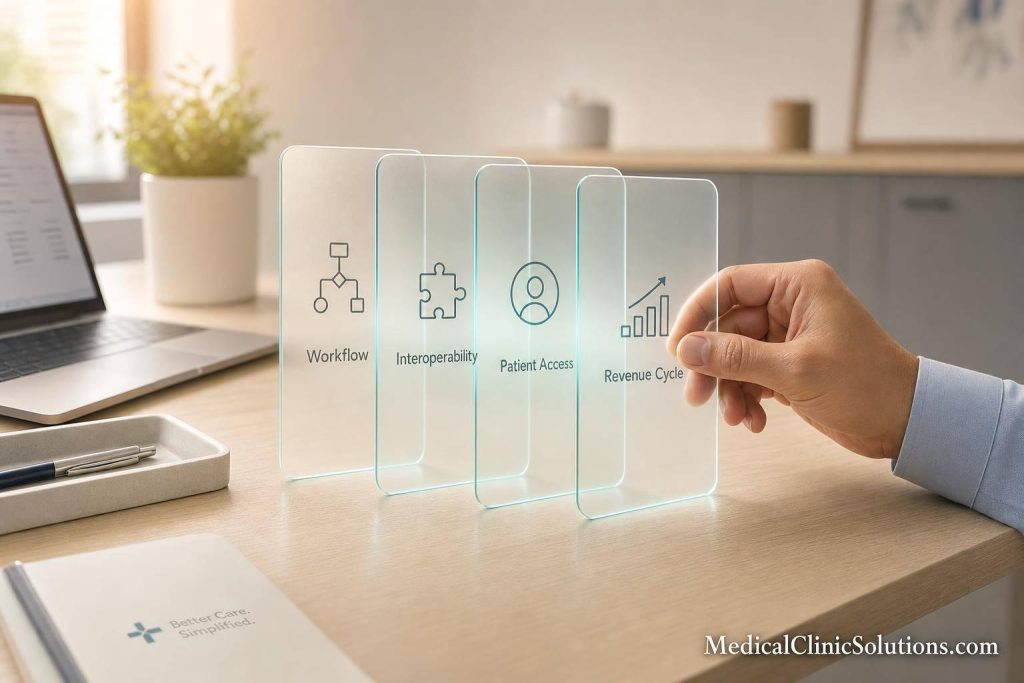
If I had to cut this down to one idea, it would be this: the best EHR in 2026 is the one that fits your clinic’s daily work, not the one with the biggest name. That matters more than ever when only 38% of organizations say their last EHR rollout fully met expectations.
If I were choosing an EHR today, I’d focus on four things first:
- Clinical workflow and documentation
- Interoperability and compliance
- Patient access and telehealth
- Revenue cycle and reporting
I’d also check for a few non-negotiables right away:
- ONC 2015 Edition Cures Update certification
- HL7 FHIR R4 API support
- Support for CPT and ICD-10 coding
- A clear 3-year total cost of ownership, not just the monthly fee
This comparison covers Epic, Oracle Health, eClinicalWorks, NextGen Healthcare, Praxis EMR, and cloud-based small-practice EHRs. The main split is simple: large systems tend to offer more depth but come with heavier setup, while smaller cloud tools are easier to launch but may have thinner billing, reporting, or data-sharing tools.
One more thing stands out in 2026: ambient AI charting is now expected. The bigger question is whether it is built in, tightly linked, or sold as an extra.
Best EHR Software of 2026 | Healthcare Software Series
Quick Comparison
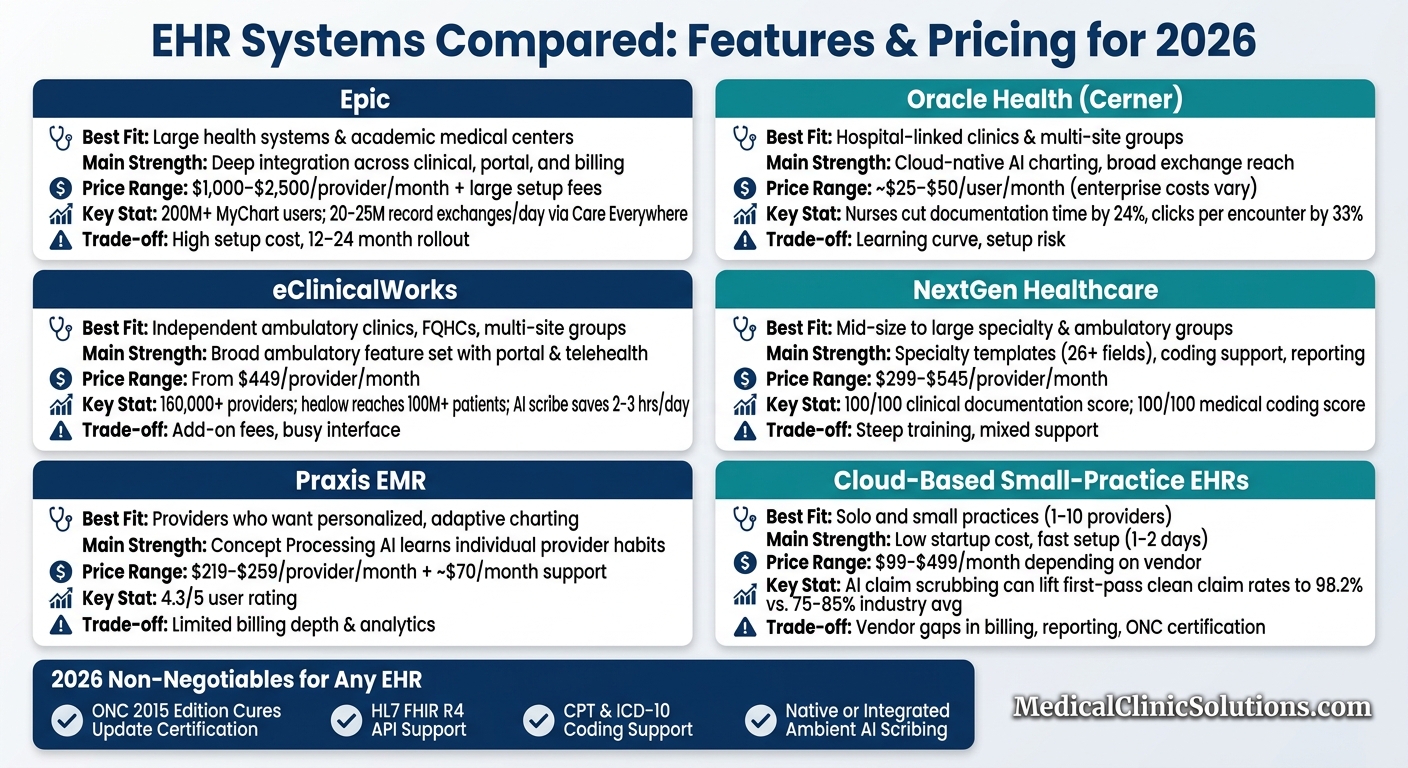
EHR Systems Compared: Features & Pricing for Clinics in 2026
| System | Best fit | Main strength | Main trade-off | Price range |
|---|---|---|---|---|
| Epic | Large health systems and affiliated groups | Deep integration across clinical, portal, and billing tools | High setup cost and long rollout | Usually custom; often $1,000–$2,500/provider/month plus large setup fees |
| Oracle Health | Hospital-linked clinics and multi-site groups | Cloud setup, AI charting help, broad exchange reach | Learning curve and setup risk | Starts around $25–$50/user/month; enterprise costs vary |
| eClinicalWorks | Independent ambulatory clinics, FQHCs, multi-site groups | Broad ambulatory feature set with portal and telehealth | Add-on fees and busy interface | Starts at $449/provider/month |
| NextGen Healthcare | Mid-size to large specialty and ambulatory groups | Specialty templates, coding support, reporting | Steeper training and mixed support experience | About $299–$545/provider/month |
| Praxis EMR | Providers who want personalized charting | Learns provider charting habits over time | Less depth in billing and analytics | About $219–$259/provider/month plus support |
| Cloud-based small-practice EHRs | Solo and small practices | Lower startup cost and fast setup | Vendor-to-vendor gaps in billing, reporting, and certification | Often $99–$499/month, depending on product and add-ons |
For most clinics, the short version is simple: Epic and Oracle Health fit bigger networks, eClinicalWorks and NextGen fit busy ambulatory groups, Praxis fits providers who want looser charting, and smaller cloud systems fit practices that want lower overhead and a faster start.
That’s the lens I’d use for the rest of the comparison.
1. Epic
Epic is at its best in large health systems, academic medical centers, and IDNs that need tight connections across charting, scheduling, billing, and patient access.
Clinical Workflow
Epic’s SmartTools let clinicians reuse content and auto-fill structured data. In 2026, Epic also added AI-powered ambient documentation to cut down manual charting time. The Cheers module supports ambulatory-specific workflows inside the broader Epic ecosystem.
That said, Epic isn’t always light on clicks. Some workflows still take a lot of configuration, and many teams need heavy personalization to make day-to-day charting feel smooth instead of frustrating.
Interoperability
Epic runs Care Everywhere, which supports 20 million to 25 million record exchanges per day. It also operates Epic Nexus, a Qualified Health Information Network (QHIN) under TEFCA, connecting 625 hospitals for data sharing.
Epic adopted USCDI v3 ahead of the December 2025 federal deadline. It also supports SMART on FHIR apps and CDS Hooks for real-time alerts.
Patient Access
MyChart serves more than 200 million active users globally. It supports scheduling, secure messaging, record access, and mobile-first engagement through Epic’s Cadence scheduling module.
RCM & Analytics
Epic’s Resolute Billing module brings clinical and financial data together on one platform. Healthy Planet supports risk stratification and analytics for value-based care. The Cosmos database supports large-scale clinical research and benchmarking. Reporting Workbench handles operational and compliance reporting.
Pricing is usually $1,000 to $2,500 per provider per month, with implementation fees ranging from $1 million to more than $500 million for enterprise deployments. Annual maintenance often adds another 15% to 20% of initial licensing costs.
For small standalone practices, implementation alone often lands between $500,000 and $1.2 million. That can put Epic out of reach unless the practice has health system backing or uses a Community Connect model.
Oracle Health takes a different path, with its own strengths in enterprise interoperability and legacy Cerner workflows.
2. Oracle Health EHR (Cerner)
Where Epic tends to serve large integrated health systems, Oracle Health is often a better fit for hospital-linked clinics and multi-site groups that want cloud deployment and AI-assisted documentation.
Clinical Workflow
The Oracle Clinical Digital Assistant uses ambient listening to build structured notes and suggest billing codes in real time. Chart Assist and Chart Search use NLP to pull chart data through natural-language search.
Oracle Health stands out for groups that want help with documentation and smoother outpatient workflows. The catch is the learning curve. If the system isn’t set up with care, high-volume documentation can feel clunky. That said, the upside can be big. At Northern Light Health, nurses cut documentation time by 24% and reduced clicks per encounter by 33%. For clinics trying to cut charting time without losing structured documentation, that’s a strong signal.
Interoperability
Oracle Health co-founded the CommonWell Health Alliance and connects to the Carequality network. Its Ignite APIs support FHIR R4 and SMART on FHIR, and the platform is TEFCA-aligned through the CommonWell QHIN.
The Oracle Health Connection Hub brings data exchange together across providers, payers, and labs. That scale shows up in rollouts like Monument Health’s move of five hospitals and 100 clinics onto one integrated platform. For spread-out organizations, that kind of network reach can matter just as much as the API layer.
Patient Access
HealtheLife gives patients 24/7 access to records, messaging, scheduling, digital intake, kiosks, and telehealth through Scheduled Video Visits and Amwell On-Demand.
These self-service tools can make a plain difference in day-to-day access. Methodist Health saw no-show rates drop by 22% and added 10,506 appointments across 73 locations after rolling out Oracle’s scheduling tools. Less friction at check-in and booking often means fuller schedules and fewer gaps in care.
RCM & Analytics
Oracle splits revenue cycle management across front-, mid-, and back-office workflows, using AI to flag avoidable denials, manage DNFB accounts, and automate payment matching. Black River Memorial Hospital reduced AR days by nearly 19% and increased monthly cash collections by 21% after implementation.
On the analytics side, the platform connects with Tableau and SAP BusinessObjects, and it links to HealtheIntent for population health and value-based care reporting.
Pricing for ambulatory settings starts at about $25 to $50 per user per month, while enterprise deployments can run into multi-million-dollar implementations. Data migration and training may push total cost 50% to 100% above the base license, so it’s smart to ask for a full 3-year TCO estimate before signing.
3. eClinicalWorks
For ambulatory clinics that want broad functionality without the weight of a huge enterprise system, eClinicalWorks lands in the middle of the market. eClinicalWorks (eCW) is a high-volume ambulatory EHR built for independent clinics, FQHCs, and multi-site groups, and it supports more than 160,000 providers.
Clinical Workflow
eCW puts a lot of focus on AI-driven charting. Sunoh.ai, its ambient scribe, listens during patient visits and turns those conversations into structured notes on its own. That can save users 2 to 3 hours per day.
The EVA virtual assistant takes on routine documentation work, and the platform includes templates for 40+ specialties. That said, the interface can feel packed with information. New staff usually need role-based training, and a slower go-live tends to work better than throwing everyone in at once.
The big draw here is simple: speed across busy ambulatory settings. Right behind that comes data sharing.
Interoperability
eCW uses PRISMA to connect with Carequality and CommonWell. It also supports TEFCA, FHIR R4, and USCDI v3.
That reach also carries over into the patient side of the platform.
Patient Access
The healow ecosystem includes the patient portal, mobile app, scheduling, digital intake, and telehealth through healow TeleVisits. healow reaches more than 100 million patients.
RCM & Analytics
On the revenue side, the built-in coding assistant links diagnoses to suggested CPT and ICD-10 codes, which helps cut down on unbundling errors and other common denial issues. Analytics tools include population health dashboards for care gaps and MIPS Quality reporting.
Pricing starts at $449 per provider per month, and eCW includes free data migration from an existing EHR. There’s also an RCM services option at about 2.9% of collections instead of the flat monthly fee.
One thing to watch: add-on transaction fees. They can push the total cost well above the base subscription.
Next, compare it with NextGen Healthcare EHR.
4. NextGen Healthcare EHR
For clinics that want specialty depth without the weight of a big enterprise system, NextGen is built for fast ambulatory workflows. NextGen Healthcare EHR is a fit for mid-to-large ambulatory and multi-specialty practices, with specialty templates for 26+ fields, including Cardiology, Dermatology, OB/GYN, Orthopedics, and Behavioral Health.
Clinical Workflow
NextGen’s Ambient Assist AI turns visit conversations into structured SOAP notes, which helps teams chart faster. In 2026 analyst reviews, the platform earned a 100/100 for clinical documentation and 100/100 for medical coding.
Its coding tools support:
- CPT
- HCPCS
- ICD-10
- NDC
It also includes built-in E&M coding suggestions to cut down on errors. Mobile tools scored 96/100 and support voice dictation, plus photo and video uploads. In busy specialty clinics, that kind of speed can make a direct difference in patient throughput.
Interoperability
NextGen supports HL7 FHIR R4 APIs and USCDI v3 data classes, which helps data move across outside care networks. It also has ONC-Health IT 2015 Edition Cures Update certification. In analyst reviews, third-party integration scored 77/100.
Patient Access
The built-in patient portal includes online scheduling, digital intake, lab result viewing, medication refill requests, and secure messaging. Telehealth is also built in, and the mobile app lets staff manage schedules while away from a desk.
RCM & Analytics
The RCM toolset includes claims scrubbing, coding support, and MIPS reporting. In analyst reviews, dashboards scored 93/100 for reporting.
There’s also a clear financial upside in the right setup:
- Syracuse Community Health Center reported a 20% increase in collections
- Claim denials fell by 10% after it rolled out NextGen’s billing and coding tools
Pricing usually runs from about $299 to $545 per provider, per month, with implementation fees ranging from $5,000 to $50,000 based on practice size and setup complexity.
The main downsides are pretty clear: a steep learning curve, uneven support, and a go-live process that can get complicated.
Smaller practices often give up some of this depth in exchange for simpler cloud setup and lighter admin work.
5. Praxis EMR
Praxis EMR is a fit for clinicians who want charting to follow their way of working instead of forcing them into rigid templates. Its Concept Processing AI learns how each provider documents over time and adjusts to those habits.
Clinical Workflow
The big draw here is personalization. Instead of working through the same fixed forms at every visit, Praxis builds around how you document specific conditions and encounter types. As you keep using it, the system starts surfacing likely content based on your charting patterns.
That said, there’s a catch. The AI takes time to learn, so the first stretch can feel slow. Setup and onboarding also take more work. So Praxis tends to make the most sense for clinicians who care more about charting freedom than template-driven speed.
Workflow Integration
Praxis brings scheduling, records, e-prescribing, labs, and medication lists into one system. The main upside is simpler day-to-day workflow inside the platform, rather than deep enterprise interoperability.
Patient Access
The platform includes a patient portal for records, intake, and secure messaging.
RCM & Analytics
Praxis has limited native RCM and less depth in analytics. Its pricing uses an ownership model:
- About $219/provider/month on a 60-month plan
- About $259/provider/month on a 48-month plan
- Ongoing support adds about $70/month
Users give it a 4.3/5 rating and often mention a dated interface and extra clicks. That trade-off matters more when compared with the cloud-based specialty and small-practice systems in the next section.
6. Cloud-Based Specialty and Small-Practice EHRs
This category is built for solo providers, small groups, and specialty practices that need strong documentation support without the weight of an enterprise system. In small practices, cloud-based EHRs now lead the market because they cut upfront costs and make remote access much easier. Compared with enterprise EHRs, these platforms give up some depth in exchange for faster deployment, lower cost, and less admin work.
Clinical Workflow
For small-practice EHRs, ambient scribing is now mostly a pricing and rollout question. The main split is simple: is it included, or does it cost an extra $35 to $125 per month? At this end of the market, the issue usually isn’t whether the feature exists. It’s how fast a clinic can start using it.
Take ClinikEHR and DrChrono. ClinikEHR, priced at $99 to $199 per month, includes ambient scribing natively and can be set up in 1 to 2 days. DrChrono, which runs $199 to $499 per month, offers it as a paid add-on.
Specialty fit also matters more than a long feature list. A primary care EHR can struggle in mental health or surgical settings if its templates are too rigid. That’s where specialty-first systems stand out. Nextech, used by more than 16,000 specialty practices, includes tools such as integrated clinical photography and procedural templates that general platforms often don’t offer.
Interoperability
Platforms in this group should support HL7 FHIR R4 APIs so they can exchange data with labs, pharmacies, and Health Information Exchanges (HIEs). Before signing a contract, check ONC certification on the Certified Health IT Product List (CHPL) at healthit.gov. If a system is missing from that list, a practice can face negative MIPS payment adjustments of up to 9%.
Patient Access
In small practices, patient portals work best when they keep scheduling, intake, messaging, and billing in one simple flow. That matters because patients don’t want to jump between tools, and staff doesn’t want that either. Most platforms in this category now include native, HIPAA-compliant telehealth, which helps clinics avoid third-party plugins.
RCM & Analytics
The billing gap between systems can be large. athenahealth charges 4% to 8% of monthly collections, but it also brings deep RCM support that fits insurance-heavy primary care well.
AI-driven claim scrubbing can lift first-pass clean claim rates to 98.2%, versus the industry average of 75% to 85%. One reported example shows how much that can matter in day-to-day operations: Magnolia Family Urgent Care increased its first-pass claims rate to about 93%, up from under 50%, after adopting Practice EHR‘s AI Claim Editor.
When comparing systems, don’t stop at the base subscription price. Costs can stack up through:
- clearinghouse fees
- e-prescribing transaction costs
- data migration fees, which usually range from $3,000 to $5,000
These trade-offs become clearer in the next section, where the systems are compared feature by feature.
Feature-by-Feature Comparison for 2026
The tables below boil the vendor profiles down to the features clinics compare most in 2026. In most cases, enterprise systems require custom quotes. Smaller ambulatory systems are more likely to publish starting prices in USD.
Clinical Workflow and Documentation
AI ambient scribing is now standard. The main split isn’t whether it exists. It’s whether the tool is native, integrated, or sold as an add-on.
| System | Charting Style | AI/Ambient Scribing | Mobile Access |
|---|---|---|---|
| Epic | Structured | Native AI-assisted ambient documentation | Haiku/Canto apps |
| Oracle Health | Modular | Ambient AI assistant | Mobile web |
| eClinicalWorks | Template-based | AI scribe / built-in coding assistant | Strong mobile/tablet access |
| NextGen Healthcare | Specialty-specific | AI-powered ambient documentation | NextGen Mobile |
| Praxis EMR | Adaptive | Concept Processing AI | Mobile web |
| Cloud-based small-practice EHRs | Simplified | AI note assist varies by vendor | Strong mobile access |
Interoperability, Compliance, and Security
Start by checking current CHPL certification. After that, compare how far each system goes with FHIR support and outside data exchange. That’s where the day-to-day gap often shows up.
| System | Interoperability Standard | HIE / Integration Reach | Security Controls | ONC Status |
|---|---|---|---|---|
| Epic | HL7 FHIR R4 / USCDI v3 | Broad ecosystem | Enterprise security controls | Certified |
| Oracle Health | FHIR R4 / cloud-based APIs | Broad | Enterprise security controls | Certified |
| eClinicalWorks | Certified interoperability support | Active ambulatory integrations | HIPAA-aligned controls | Certified |
| NextGen Healthcare | FHIR / HIE connectivity | Active | Audit trails and access controls | Certified |
| Praxis EMR | Standard connectivity | Limited | HIPAA-compliant controls | Verify current CHPL listing |
| Cloud-based small-practice EHRs | Varies by vendor | Varies | Varies by vendor | Verify current CHPL listing |
Patient Portal, Scheduling, and Telehealth
Patient access works best when scheduling, messaging, intake, and telehealth sit in one flow instead of feeling patched together. That’s often the difference between a portal patients use and one they ignore.
| System | Patient Portal | Self-Scheduling | Telehealth | Digital Intake |
|---|---|---|---|---|
| Epic | MyChart | Integrated | Native video + AI scribe | Yes |
| Oracle Health | Integrated portal | Available | Embedded AI assistant | Yes |
| eClinicalWorks | healow | healow Open Access | Integrated healow Telehealth | Yes |
| NextGen Healthcare | NextGen PXP | Available | Integrated virtual visits | Yes |
| Praxis EMR | Basic portal | Limited | Limited | Yes |
| Cloud-based small-practice EHRs | Integrated | Available | Native telehealth varies by vendor | Yes |
Revenue Cycle and Reporting
Revenue cycle depth ranges from basic billing to enterprise-grade denial tracking. Mid-market systems often package in MIPS and quality reporting, which can matter a lot for busy ambulatory groups.
Billing depth and reporting often decide whether a system fits a clinic’s volume and payer mix. A platform can look fine on the clinical side and still create headaches if claims follow-up is thin.
| System | Billing Integration | Denial Tracking | MIPS/Quality Reporting | Typical Pricing |
|---|---|---|---|---|
| Epic | Resolute (enterprise) | Enterprise-grade | Yes | Enterprise quote |
| Oracle Health | Integrated RCM | Enterprise-grade | Yes | Enterprise quote |
| eClinicalWorks | Integrated RCM and coding assistant | Built in | Yes (QRDA I/III) | $449–$599/provider/month |
| NextGen Healthcare | Integrated PM/RCM | Built in | Yes | Enterprise quote |
| Praxis EMR | Limited native RCM | Basic | Limited | ~$219–$259/provider/month |
| Cloud-based small-practice EHRs | Varies by vendor | Basic to moderate | Varies by vendor | Varies by vendor |
Pros and Cons by System
No single EHR leads in every area. The best choice depends on your clinic’s size, specialty, budget, and how much IT work your team can handle. A simple way to narrow the list is to use the same four filters from the comparison above: workflow, interoperability, patient access, and RCM. Big systems tend to buy depth. Smaller practices tend to buy speed.
| System | Key Pros | Key Cons | Best-Fit Clinic Profile |
|---|---|---|---|
| Epic | Broad interoperability (Care Everywhere); deep analytics; MyChart patient portal | Implementation costs from $500,000 to $1.2 million for standalone small practices; 12–24 month go-live timeline; steep learning curve | Large health systems, academic medical centers, and system-affiliated groups with dedicated IT staff |
| Oracle Health (Cerner) | Established federal and VA footprint; cloud-native OCI infrastructure; native Clinical AI Agent for ambient documentation | Post-acquisition transition uncertainty; interface can feel dated; inconsistent implementation support | Government hospitals, VA facilities, and large systems prioritizing cloud-native architecture |
| eClinicalWorks | All-in-one suite with strong telehealth (healow); deep clinical customization and multi-specialty depth; lower monthly pricing at $449 to $599 per provider per month | Complex, click-heavy interface; history of regulatory scrutiny; steep initial learning curve | High-volume multi-specialty groups, primary care, and pediatric practices needing a full-stack ambulatory platform |
| NextGen Healthcare | Deep specialty-specific templates for behavioral health, orthopedics, and OB/GYN; strong RCM integration; active FHIR development | Implementation complexity varies by product tier; interface can feel dated | Specialty clinics and community health centers with defined workflow requirements |
| Cloud-based small-practice EHRs | Fast onboarding; strong mobile access; lower monthly costs | Thinner analytics and billing depth; interoperability and ONC certification vary by vendor; private equity has driven price increases of 15% to 70% for some vendors in 2025 | Solo-to-10 provider practices on tighter budgets prioritizing ease of use over deep customization |
The trade-offs in the table point to the next issue: how much implementation effort your clinic can take on without slowing the business down. In 2026, the big trade-off is implementation burden vs. long-term capability. That tension shows up fast for small and mid-size practices. A lighter system may get you live sooner, but weaker analytics and billing tools can create problems later if they drag on revenue.
That’s why price should be judged by 3-year total cost of ownership, not the subscription fee alone.
Conclusion
In 2026, the best EHR isn’t the one with the longest feature list. It’s the one that fits your clinic’s size, specialty, day-to-day workflow, interoperability needs, patient access goals, and revenue cycle demands.
That’s why workflow fit is the factor that matters most.
The four things that shape the decision are workflow, interoperability, patient access, and revenue cycle. Get those right, and an EHR can cut friction across the practice. Get them wrong, and it can slow everyone down.
ONC certification is mandatory. Native ambient scribing is now table stakes too. The main difference is whether that function comes built in or shows up as a third-party add-on.
In 2026, the right EHR is the one your staff can use with ease, your patients can get into without hassle, and your revenue cycle can depend on day after day.
FAQs
How do I estimate 3-year EHR costs?
To estimate 3-year EHR costs, look past the monthly per-provider fee and work out the total cost of ownership.
That means adding up more than just the base subscription. You’ll also want to factor in implementation, data migration, training, support, and any repeat fees for billing, revenue cycle management, telehealth, and AI tools.
Ask the vendor for a written breakdown that shows what’s bundled and what costs extra. That way, you’re not stuck piecing it together later.
Medical Clinic Solutions can help connect your practice with information on EHR systems and related services.
Which EHR features matter most for my specialty?
Focus on how well the EHR fits your specialty’s day-to-day work, not just a generic feature list. A primary care practice, for instance, may need preventive care tracking and e-prescribing front and center. An urgent care clinic or behavioral health practice may need very different charting, intake, and visit-flow tools.
That’s why it helps to look closely at specialty-specific templates, interoperability, integrated billing, patient engagement tools, and room to grow as your practice changes. If you want help narrowing the options, Medical Clinic Solutions can connect U.S. practices with EHR and related software choices that match their needs.
Is built-in ambient AI worth the extra cost?
Often, yes. Ambient AI can cut documentation time and save providers up to 120 minutes a day. That time can go back into patient care instead of getting eaten up by notes.
The math, of course, depends on pricing. Some EHRs include ambient AI in the base product. Others charge $35 to $125 per provider per month. When the AI is built into the EHR and trained for clinical use, it can make work smoother without adding extra clicks.