
EHR Training Costs vs. ROI: Is It Worth It?

Yes – if I look at the full picture, EHR training is often worth the cost. The upfront bill can run from $10,000 to $100,000+, and many practices lose 20%–30% of patient volume for 3–6 months after go-live. But trained teams often recover sooner, cut denials, improve coding, and can break even in about 18–36 months.
Here’s the short version:
- I need to count both direct costs and lost productivity
- Weak training can stretch the slowdown from 3–4 months to 6–12+ months
- Better training can help lower denials from 8%–12% to 3%–5%
- Coding and charge capture may add $20,000+ per FTE per year
- Year 1 is often negative, but Year 2 can look much better for some practices
If I judge training by the invoice alone, I miss the part that affects revenue, staff time, and error rates. The better question is simple: does training help my practice get back to full speed faster and collect more of what it already earns?
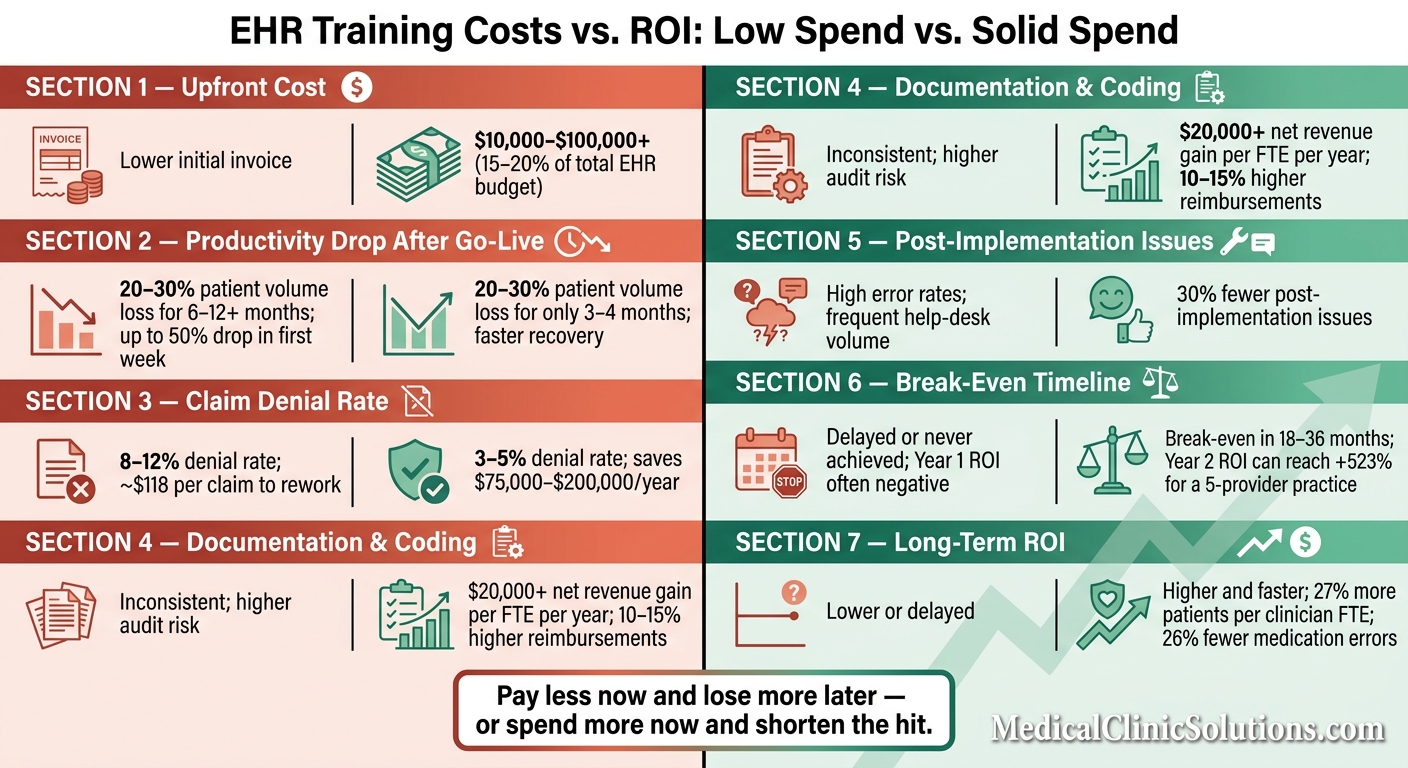
EHR Training Investment: Low vs. Solid Spend – Costs, ROI & Break-Even
How to Calculate ROI for Your EHR Investment
Quick Comparison
| Factor | Low Training Spend | Solid Training Spend |
|---|---|---|
| Upfront cost | Lower | Higher |
| Productivity drop | Often longer | Often shorter |
| Time to recover | 6–12+ months | 3–4 months |
| Denials and rework | More common | Less common |
| Documentation quality | Less steady | More accurate |
| Long-term ROI | Lower or delayed | Higher or faster |
So when I compare EHR training cost vs. ROI, the answer usually comes down to one thing: pay less now and lose more later, or spend more now and shorten the hit.
EHR training costs: what practices pay upfront
Training and go-live support usually make up 15%–20% of the total EHR implementation budget. And that number doesn’t tell the whole story.
Practices pay in two ways: direct spend and indirect productivity loss. So the issue isn’t just, “What does training cost?” It’s also, “What does that spend help you earn back later?”
Direct costs: vendor fees, staff training time, and support
The clearest costs are vendor-led training and the hours your team spends in training instead of doing regular work.
Initial training for one staff member usually costs $1,000–$5,000, depending on the vendor and how deep the program goes. If you bring the vendor on-site, expect $1,500–$3,000 per day, plus travel. Virtual sessions are less expensive, usually $500–$1,200 per session.
Staff time adds up too. Physicians average about 23.9 hours of EHR training, while nursing staff usually need 15–20 hours. That’s a lot of time pulled from clinic work, even before go-live starts.
Superuser training is its own budget line. Each internal superuser usually costs $2,000–$5,000 to train, plus either a $500–$2,000 annual stipend or about a 0.1 FTE reduction to support the role over time. Go-live support can add another $20,000 to $100,000, based on practice size.
Across the board, full training budgets tend to look like this:
- $10,000–$30,000 for solo or small practices
- $30,000–$100,000 for mid-size groups
- $100,000–$375,000 for large groups
Indirect costs: slower schedules, overtime, and short-term disruption
The hidden costs are often the ones that hit hardest.
After go-live, physicians usually see 20%–30% fewer patients for the first 3–6 months. In the first week alone, patient volume can fall by as much as 50%. When lost billable physician time runs $250–$400 per hour, that drop gets expensive fast.
For a 5-provider practice, even a 25% productivity drop can turn into a six-figure revenue hit in a hurry.
Back-office teams often soak up the mess through overtime, which can add $20,000–$100,000 in labor costs. Some practices also bring in temporary staff just to keep the place moving while regular employees are in training or adjusting to new workflows.
That’s why short-term training costs can’t be looked at in isolation. The up-front spend is only one side of the ROI equation. The other side is whether that spend cuts friction, shortens the slowdown, and helps the practice get back to normal faster.
ROI from EHR training: where the return actually comes from
After the upfront spend, the main question is simple: how fast does training pay for itself? The answer usually has less to do with buying an EHR and more to do with using it well. A team that gets role-based training tends to bring in more revenue, work faster, and make fewer mistakes than a team pushed through rushed onboarding.
Financial returns: better coding accuracy and fewer denials
The biggest dollar gains from EHR training usually come from medical billing services improvements like better coding and fewer claim denials. When staff know how to document visits the right way and use the EHR’s coding features well, fewer charges slip through the cracks and reimbursement levels go up. EHR-driven coding can produce $20,000+ in net revenue per FTE per year. In mid-size practices, coding gains alone can lift reimbursements by 10%–15%, which can mean $100,000 to $300,000 per year.
Denials are the other big driver. About 90% of claim denials are preventable, and each denied claim costs about $118 to rework. When teams are trained to verify eligibility, document cleanly, and send accurate claims the first time, denial rates can drop from the 8%–12% range to 3%–5%. That can bring back $75,000–$200,000 per year.
For a 5-provider practice in year 2, the math can look like this:
ROI = ((Total Benefits – Total Costs) / Total Costs) x 100
- Total Benefits: $193,000 (improved capture, reduced denials, increased patient volume)
- Total Costs: $31,000 (subscription, ongoing support, refresher training)
- ROI: 523%
Workflow and clinical returns: faster processes, safer care, and stronger documentation
The return doesn’t stop at billing. Training also improves day-to-day workflow and patient care. Practices with trained teams see an average 27% increase in the active-patients-to-clinician FTE ratio once workflows settle in. In plain English, that means seeing more patients without hiring more people.
The safety data stands out too. EHRs cut medication errors by 26% and diagnostic errors by 32%. On top of that, between 85% and 98% of trained physicians say they see fewer medical errors and better documentation accuracy.
A good example comes from Kaiser Permanente Southern California. Its 3-day training program for 3,500 physicians improved documentation efficiency and increased order-set use.
Training quality tends to matter most in the areas below:
| ROI Category | Training Quality Impact | Primary Benefit |
|---|---|---|
| Billing & Revenue | High | Better coding accuracy; $20,000+ gain per FTE per year; 10%–15% higher reimbursements |
| Efficiency | Very High | 27% higher active-patients-to-clinician FTE ratio; 40% faster user adoption |
| Compliance | High | MIPS/quality reporting support; reduced audit risk |
| Patient Safety | High | 26% fewer medication errors; increased evidence-based order set use |
| Staff Satisfaction | Very High | 11+ hours of onboarding supports higher long-term EHR satisfaction; 30% fewer post-implementation issues |
Training costs vs. ROI over time: when practices usually break even
The main issue isn’t whether training costs money. It does. The bigger issue is how long it takes to earn that money back.
With EHR training, most practices take a hit first and see gains later. There’s usually a short stretch where costs go up, productivity drops, and the return looks bad on paper. ROI starts to show only when staff stop fighting the system, stop building workarounds, and begin using it the way it was meant to be used.
Year 0 to Year 1: high costs and lower productivity
Year 1 is usually the toughest and most expensive stretch. Training costs arrive first, while productivity takes time to come back.
Most practices see 20%–30% fewer patients during the first 3–6 months after go-live. In some cases, patient volume drops by more than 50% in the first month. That kind of slowdown adds up fast. For a practice billing $2 million per year, a 25% productivity loss over four months works out to about $167,000 in lost revenue.
So yes, Year 1 ROI is often negative. For a 5-provider practice, it often lands near -36%. That’s why many groups plan for a buffer of 5%–15% of first-year revenue.
That early loss is exactly why break-even timing matters more than the first invoice.
Year 2 and beyond: stable workflows and measurable gains
Once the first year is out of the way, the picture usually changes. After about 18–36 months, workflows settle down and the financial gains tied to training start to build on each other.
Smaller practices with simpler workflows often reach break-even sooner. Larger groups usually take longer. In a 5-provider practice, Year 2 ROI can reach +523%, driven by better coding accuracy and fewer denials once staff use the system as trained.
There’s a simple pattern here: more training up front usually means a shorter productivity slump. Cutting training to save money can backfire. It pushes the return further out and shrinks it.
Training depth affects both how fast a practice recovers and how much it gets back over time.
| Metric | Low Training Investment | Adequate Training Investment |
|---|---|---|
| Time to Productivity Recovery | 6–12+ months | 3–4 months |
| Documentation Quality | Inconsistent; higher audit risk | High accuracy; $20,000+ charge capture gain per FTE |
| Post-Implementation Issues | High error rates; frequent help-desk volume | 30% fewer post-implementation issues |
How to get more out of your EHR training investment
Build a training plan around roles, workflows, and regular refreshers
Once you’ve answered the break-even question, the next move is simple: improve how training gets delivered. Generic training sounds efficient on paper, but in practice it burns time and slows adoption. People should learn the parts of the system they’ll use day to day, not sit through sessions packed with steps that don’t apply to their jobs.
A better approach is to train each role around its actual workflows. That means physicians focus on charting, orders, and coding. Front-desk teams focus on check-in, registration, and eligibility. Billing teams focus on claim prep and denial prevention. When training lines up with real work, staff pick it up faster and use it with less friction.
Set up a superuser program early. Pick respected staff members with strong system skills 5–6 months before go-live and train them ahead of everyone else at a cost of $2,000–$5,000 per person. Then, during go-live week, take them out of 100% of clinical duties so they can give hands-on help to coworkers in the moment. That kind of floor support can make a big difference when people hit a snag and need an answer right away.
It also helps to record virtual training sessions. Those recordings become a reusable library for onboarding new hires and for short refreshers when workflows change. And when you’re working through the contract, push for 80 to 100 training hours, not 40. Forty hours may look fine at first glance, but it can disappear fast once you spread it across roles, teams, and follow-up support.
Here’s what role-based training can look like in practice:
| Staff Role | Efficiency Gain | Collections Impact |
|---|---|---|
| Physician | 40–60 min saved/day | 10%–15% better coding accuracy |
| Nurse/Clinical | 15–30 min saved/day | N/A |
| Front Desk | 10%–20% faster check-in | 2%–5% from eligibility and registration |
| Billing/RCM | 20% faster claim prep | 23% fewer denials |
This is where training starts to look less like an expense and more like a business decision. To keep that momentum, schedule check-ins at 30, 90, and 180 days. Those sessions help catch bad habits early, before they turn into the “that’s just how we do it now” kind of problem.
Use Medical Clinic Solutions to compare EHR-related support options
If you’re still picking a system, look at the training and support terms just as closely as the software itself. Medical Clinic Solutions can help practices compare EHR systems and related support options based on size, specialty, and budget. Medical Clinic Solutions is an information source and connection point, not a direct provider of those services.
Conclusion: when EHR training is worth the cost
EHR training comes with real upfront costs. But weak training – or skipping it – doesn’t cut costs. It usually delays the return and can shrink it. Practices that put enough into structured, role-based training tend to see faster adoption and fewer post-implementation issues. Training is worth the cost when it fits the role and continues after go-live.
FAQs
How much EHR training do most practices actually need?
Most practices should plan for at least 3 to 5 hours of initial onboarding, plus another 3 to 5 hours of training each year. And when clinical staff get 11+ hours of training, they often say they’re more satisfied with the system.
That said, vendor estimates can be a bit optimistic. You may hear numbers like 8 to 20 hours, but getting people back to their pre-transition productivity usually takes more time, often 40 to 80 hours per user during the first 90 days.
If you’re training super-users, budget even more time. That part usually adds 80 to 120 hours.
What causes EHR training ROI to vary by practice?
EHR training ROI looks different from one practice to the next. A small clinic won’t see the same payback as a large group, and a simple setup won’t demand the same effort as a more complex system. The way training is delivered matters too.
Practices that put money into structured, in-depth training tend to get better results. In many cases, that means more than 11 hours of training per clinician. When teams get that level of support, adoption usually happens faster and proficiency tends to improve.
A few other factors shape ROI in a big way:
- Staff time spent away from patient care
- Use of internal super-users to support day-to-day learning
- The strength of change management during rollout
One thing is clear: inadequate training is a leading cause of implementation failure.
How can I shorten the post-go-live productivity drop?
Put serious focus on change management and role-based training. Companies that spend time here see 40% faster time to positive ROI.
Start training 5 to 6 months before go-live with super users. Then run intensive end-user sessions during the final 4 to 6 weeks. Aim for at least 11 hours of hands-on training tailored to each role, and set aside budget for on-site go-live support.