
EHR Go-Live Timeline: Best Practices for Success
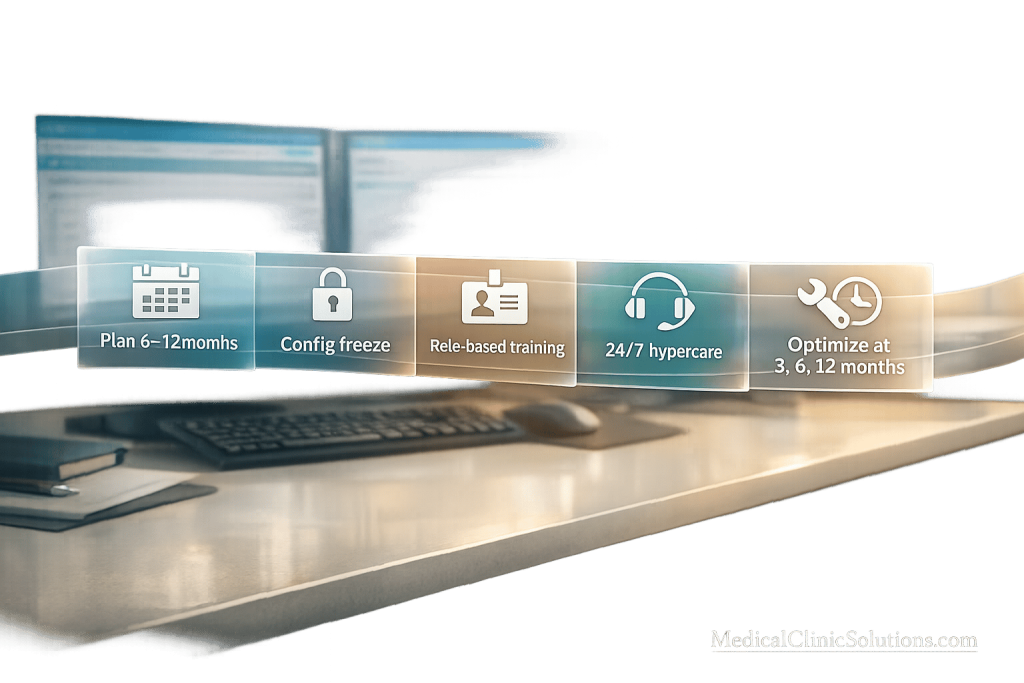
The EHR go-live process is a critical turning point for healthcare practices, impacting patient care, workflows, and financial performance. Missteps during this phase can lead to billing delays, staff burnout, and long-term inefficiencies. Here’s what you need to know to ensure success:
- Timeline Planning: Allocate 6–12 months for preparation, including workflow mapping, testing, and setting clear goals.
- Pre-Go-Live Readiness: Freeze system changes 2–4 weeks before launch. Audit and clean data months in advance to avoid errors.
- Training: Conduct role-specific training and enforce a "No Training, No Access" policy to ensure staff readiness.
- Post-Go-Live Support: Provide 24/7 IT assistance during the first 10 days and schedule workflow reviews at 3, 6, and 12 months.
Rushing, skipping steps, or neglecting post-launch optimization can undermine the entire implementation. Success lies in thorough preparation, tailored training, and ongoing improvements.
1. Successful EHR Go-Live Approaches
Timeline Alignment
A well-structured timeline is the backbone of a successful EHR go-live. The process typically spans 6–12 months and is broken into key phases: planning, setup, training, testing/migration, and final preparations. Rushing or skipping any of these stages can lead to expensive setbacks after launch.
One crucial but often overlooked step in planning is workflow mapping. This involves tracing the entire patient journey – from intake to discharge – before implementing the software. The aim isn’t just to digitize existing processes but to improve them, which can enhance both clinical workflows and patient care. Organizations that include clinical leaders early in the process, through a multidisciplinary steering committee (comprising physicians, IT, finance, and compliance), report 30% higher satisfaction rates after go-live. Setting SMART goals, like "achieve 90% clinician adoption within the first 60 days", ensures accountability and measurable progress. This careful planning lays the groundwork for critical readiness activities in the final month before launch.
Pre-Go-Live Readiness
The final month before launch is where preparation determines success or failure. A configuration freeze, which stops system changes 2–4 weeks before go-live, ensures staff train on the exact version of the software they’ll use on day one. Another key focus is data integrity. Legacy databases should be audited for errors and duplicates at least 3–4 months prior, with test migrations of 10–20 sample records to validate formatting before transferring live data. As Cortney Swartwood from ChartPath explains:
"An EHR migration is not complete until clinical workflows function reliably."
Training and Support
Tailored, role-specific training is far more effective than generic overviews. Doctors, nurses, and billing staff should each focus on the features relevant to their daily tasks, enabling smoother workflows from day one. Enforcing a "No Training, No Access" policy – where access credentials are only granted after competency is demonstrated – ensures everyone is prepared.
The first 10 days after launch, often called the hypercare period, are critical. During this time, 24/7 IT support and on-site "floor walkers" provide immediate assistance, boosting staff confidence and adoption rates. Reducing patient volume during the first 1–2 weeks also gives staff the opportunity to practice using the system without the stress of a packed schedule. These measures are key to a smooth transition and set the stage for ongoing improvements.
Post-Go-Live Optimization
After the initial launch, addressing common challenges like billing delays and workflow disruptions becomes essential. Regular workflow reviews – conducted at 3, 6, and 12 months – can account for around 70% of efficiency improvements, helping organizations maximize their return on investment.
"Without planned optimization and ongoing training post-live, healthcare organizations miss the opportunity to generate maximum ROI from their new system." – Med Tech Solutions
For example, AI-powered documentation tools, when properly implemented and supported with adequate training, can reduce clinical documentation time by 40% and improve overall productivity by more than 30%. These benefits don’t materialize immediately but are built through consistent refinement in the months following go-live.
2. Unsuccessful EHR Go-Live Approaches
Timeline Alignment
Rushing the timeline for an EHR implementation often leads to a chain reaction of problems. Key steps like vendor selection and workflow mapping get squeezed into shorter timeframes, leaving little room for thorough planning. As Blue Eagle Consulting aptly notes:
"Rushing early steps almost always causes problems later."
Many organizations underestimate the time required for a full transition. A realistic EHR implementation typically takes 6–12 months. Shortening this timeline – especially during the planning phase – results in skipped steps and last-minute chaos.
Pre-Go-Live Readiness
Starting data cleanup late in the process is a common and critical mistake. Ideally, legacy databases should be audited at least 12 months before go-live. Waiting until the final weeks increases the risk of migrating issues like duplicate records, incomplete patient histories, or billing errors into the new system. Once these errors are in the new EHR, they become much harder to fix.
Another overlooked step is the Technical Dress Rehearsal (TDR). This full-scale simulation tests hardware, system integrations, and overall performance under real-world conditions. Skipping the TDR might save time, but it leaves organizations vulnerable to discovering serious technical problems on the actual go-live day.
These gaps in preparation often ripple into challenges with training and support.
Training and Support
Poorly planned training is a major contributor to EHR implementation struggles. Training that begins too early – more than 8 weeks before go-live – often leads to skill decay, with 50–80% of learned skills fading within 30 days without proper reinforcement. Additionally, generic, "one-size-fits-all" training approaches, used by 72% of organizations, fail to address the specific needs of different roles. This leaves physicians disengaged and administrative staff confused.
The impact of inadequate training is clear: organizations that bypass structured training are 3.5 times more likely to have physicians report a poor experience with the EHR system. Even when training is provided, only 43% of physicians and 33% of nurses find initial sessions effective.
Post-Go-Live Optimization
Failing to prioritize post-go-live practices can make initial problems worse. Without a strong stabilization plan, issues like slowed workflows, billing errors, and reliance on workarounds can become permanent obstacles.
"Treating go-live as the finish line… is a pitfall avoided by approaching go-live as just the beginning of the EHR journey." – MacKenzie Gonnelly, Med Tech Solutions
Another common error is withdrawing on-the-floor support too soon. When support ends abruptly after the first week, staff often revert to inefficient habits. In fact, 60% of organizations that skip post-go-live reinforcement end up with workarounds that persist long-term.
Best Practices for Implementing a New EHR System
Pros and Cons at a Glance
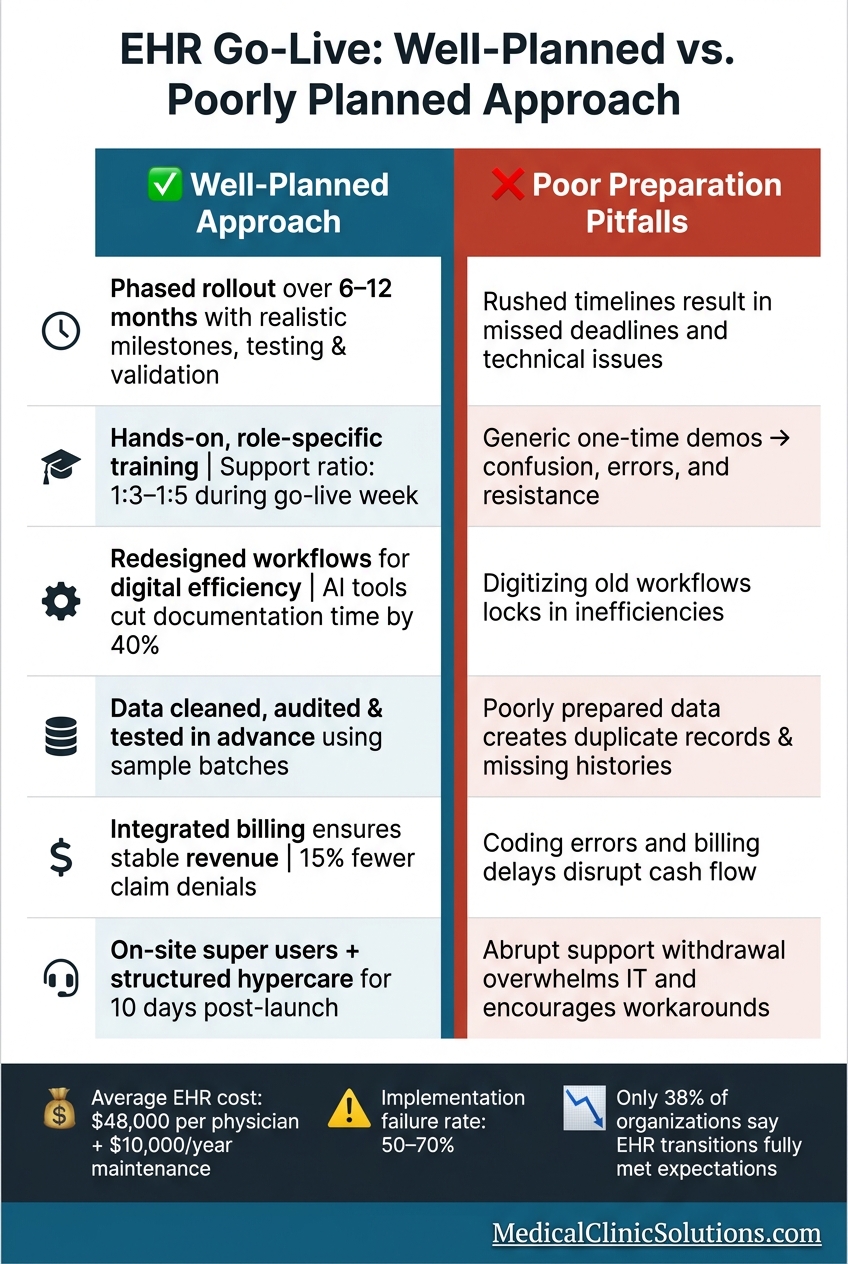
EHR Go-Live: Well-Planned vs. Poorly Planned Approach
Here’s a quick comparison of what separates a smooth EHR go-live from one riddled with challenges:
| Criteria | Well-Planned Approach | Poor Preparation Pitfalls |
|---|---|---|
| Timeline Alignment | Phased rollout over 6–12 months with realistic milestones; includes testing and validation | Rushed timelines result in missed deadlines and technical issues |
| Staff Training | Hands-on, role-specific training with a 1:3–1:5 support ratio during go-live week | Generic, one-time demos lead to confusion, errors, and resistance |
| System Optimization | Redesigned workflows for digital efficiency; AI tools cut documentation time by 40% | Simply digitizing old workflows locks in inefficiencies |
| Data Migration | Data cleaned, audited, and tested in advance using sample batches | Poorly prepared data creates duplicate records and missing histories |
| Revenue Impact | Integrated billing ensures stable revenue; 15% fewer claim denials | Coding errors and billing delays disrupt cash flow |
| Go-Live Support | On-site super users and structured hypercare for 10 days post-launch | Abrupt withdrawal of support overwhelms IT help desks and encourages workarounds |
One major financial factor to consider: EHR implementation costs average $48,000 per physician, with ongoing maintenance adding about $10,000 per physician annually. This hefty investment underscores the importance of getting it right from the start.
"Poor EHR implementation can lead to increased charting time, billing delays, staff burnout, and workflow bottlenecks." – Pabau
Conclusion
The success of an EHR go-live largely hinges on how well your practice prepares for the transition. With implementation failure rates hovering between 50% and 70%, and only 38% of healthcare organizations stating that their EHR transitions fully met expectations, careful planning, focused training, and solid post-launch support are non-negotiable.
The most successful practices treat go-live as more than just a technical change – they see it as an opportunity for clinical and leadership growth. They begin redesigning workflows 9–12 months in advance, train staff in role-specific environments, designate super users to champion the process, and continue making adjustments long after the initial rollout. This approach ensures that clinical workflows remain dependable throughout the migration.
The real benefits of EHR adoption come through continuous improvement. Regular reviews at 3, 6, and 12 months help address early obstacles and unlock long-term advantages. This ongoing effort is critical to making the most of what is often a significant financial and operational investment for each physician.
For practices seeking guidance in these crucial decisions, Medical Clinic Solutions offers a helpful starting point. They connect healthcare providers with EHR systems, medical billing services, and other tools tailored to their unique needs, ensuring you find the right solution before committing to a major implementation.
FAQs
Who should be on the EHR go-live steering committee?
An EHR go-live steering committee plays a crucial role in ensuring a smooth implementation by addressing technical, clinical, and administrative needs. To cover all bases, the committee should include the following key members:
- Project Manager: Responsible for keeping timelines on track and managing budgets effectively.
- IT Lead: Oversees the technical setup and ensures all systems function seamlessly.
- Clinical Champion: Often a physician or nurse, this person bridges the gap between clinical teams and the project, ensuring the system meets their needs.
- Billing Lead: Focuses on integrating the revenue cycle to avoid disruptions in financial processes.
- Compliance Officer: Ensures the system adheres to HIPAA standards and other regulatory requirements.
- Super Users: These are team members trained to provide peer support, offering guidance and troubleshooting to colleagues during the transition.
Having this diverse group ensures every critical aspect of the EHR implementation is addressed, setting the stage for success.
What should be included in a technical dress rehearsal?
A technical dress rehearsal needs to happen in an environment that mirrors the production setup. Use realistic data and real user accounts to simulate actual conditions. Pay close attention to end-to-end workflows to uncover any hidden problems. This includes verifying data integrity, user access, and permissions – even accounting for unusual situations like team member absences.
One critical step: test rollback procedures to confirm you’re prepared for emergencies. Make sure to document every decision thoroughly, creating an audit trail that ensures accountability and provides clarity when it’s time for the final launch.
How can we prevent revenue loss right after go-live?
When a clinic transitions to a new EHR system, there’s bound to be a temporary dip in productivity. To keep revenue loss to a minimum, it’s smart to plan ahead. Start by scheduling the go-live during a time when patient volume is typically lower. Additionally, consider reducing patient appointments in the first week. This gives your staff some breathing room to adjust to the new system.
Make sure workflows are thoroughly tested and validated beforehand to avoid hiccups, especially with billing systems. Lastly, keep a close eye on performance during the initial rollout so any issues can be addressed quickly. For clinics looking for extra support, Medical Clinic Solutions offers tools and services designed to make the transition as smooth and profitable as possible.